
The word “elope” gets used two very different ways today. Most people think of couples running off to marry in secret, but the same word also carries a serious, unrelated meaning in autism and healthcare settings.
This guide covers the full elope meaning across every context, with real examples and clear comparisons.
Quick Answer
To elope generally means to run away secretly to get married, often without a formal ceremony or family involved. In autism and healthcare contexts, “elopement” means something entirely different: a person leaving a supervised safe area without permission, which is treated as a real safety concern.
What Does Elope Mean?
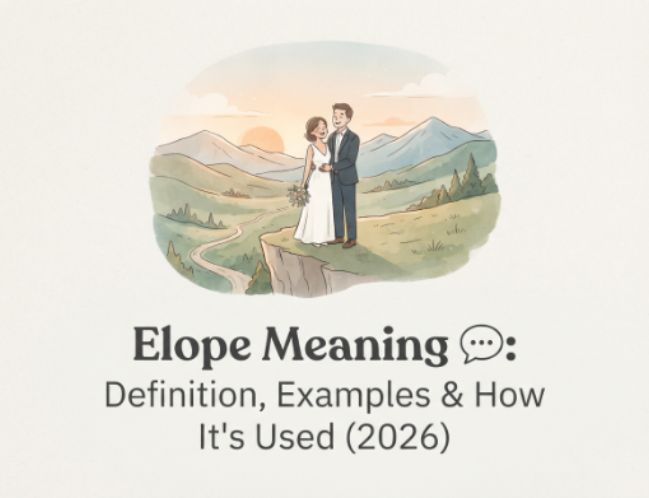
At its core, the elope meaning describes a couple marrying suddenly and privately, usually without a big wedding, guest list, or sometimes without telling family beforehand. Example: “They eloped to Las Vegas over the weekend.”
Does Elope Always Mean Getting Married Secretly?
Not anymore, at least not strictly. While secrecy was once central to the word, today “eloping” is often used more loosely to describe any small, simple, or unconventional wedding, even one where family already knows and approves. The emphasis has shifted from secrecy toward simplicity.
How Context Changes the Meaning of Elope
Secret Marriage
The traditional sense: a couple marries without telling anyone in advance, often to avoid family disapproval or a long engagement process.
Small Wedding
A modern, looser sense: a couple has a tiny, intimate ceremony with few or no guests, even if family is aware and supportive.
Destination Wedding
Increasingly, “eloping” describes traveling somewhere scenic to marry with just the couple present, treating it more like a private wedding trip than a secret escape.
Romantic or Playful Usage
Sometimes used casually and affectionately, as in “let’s just elope,” meaning skip the planning stress and keep things simple.
Elope in Autism, Special Needs, and Healthcare — A Different Meaning
What “Elopement” Means in Autism Care
In autism and special education, elopement refers to a person, often a child, leaving a designated safe area or a caregiver’s supervision without permission or awareness of the danger involved. This has nothing to do with marriage.
Elopement Risk in Children
According to CDC-related research, elopement or wandering affects nearly half of autistic children at some point. It’s often driven by sensory overload, anxiety, or a strong pull toward a preferred place, not intentional defiance.
Elopement in Hospitals and Elder Care
The same term is used in hospitals and elder care to describe a patient with cognitive impairment leaving a supervised unit or facility without staff knowledge, which can also pose serious risks.
Why This Meaning Matters for Safety
Because elopement can quickly turn into a life-threatening emergency, especially involving traffic or water, caregivers and clinicians treat it as a serious, trackable safety issue rather than a minor incident. Recognizing the signs and having a response plan matters far more here than in the romantic sense of the word.
“Let’s Elope” — Meaning and Common Usage
When someone says “let’s elope,” they’re usually suggesting a spontaneous, low-key wedding instead of a large traditional one. It can be said seriously, as an actual plan, or jokingly, as a way to express wanting to skip wedding stress altogether.
Elope Meaning in Text and Chat
In texts, “elope” almost always keeps its romantic meaning. Example: “We’re thinking about eloping instead of doing a big wedding, what do you think?” It rarely appears as slang with a different meaning the way some newer acronyms do.
Elope Meaning on TikTok, Instagram, and Snapchat
On social media, “elopement” often appears in wedding-content captions, showing small, scenic ceremonies. It’s frequently used as a hashtag or caption style: “we eloped ☀️” alongside photos from an intimate ceremony.
Real Conversation Examples
Friends
A: “So when’s the big wedding?” B: “Actually, we’re planning to elope next month.”
Family
A: “Why didn’t you tell us before the wedding?” B: “We wanted to elope, just the two of us, no pressure.”
Social Media
Caption: “We eloped at sunrise, just us and the mountains 🌄”
Is Eloping Considered Rude to Family?
It can feel that way to some families, especially if they were hoping to be part of the planning or ceremony. Reactions vary widely. Some families feel hurt or excluded, while others understand and support the choice, especially when it’s explained ahead of time rather than discovered afterward.
Is Elopement Romantic?
For many couples, yes. Eloping can feel deeply romantic because it centers the relationship itself rather than logistics, guest lists, or expectations. Others find it less appealing if they value having loved ones present for the moment.
Elope vs. Marriage: What’s the Difference?
| Aspect | Elope | Traditional Marriage |
|---|---|---|
| Planning | Minimal, often spontaneous | Extensive, often months in advance |
| Guests | Few or none | Family and friends typically invited |
| Notice | Sometimes secret or last-minute | Usually announced in advance |
| Focus | Simplicity and privacy | Ceremony and celebration |
Both result in a legal marriage; the difference lies in scale, notice, and how much family involvement is expected.
Can Muslims Elope? Religious and Cultural Perspectives
Views and practices vary widely depending on culture, family, and interpretation. In many Muslim communities, marriage traditionally involves family approval and a formal nikah ceremony, which can make an unannounced elopement less common or discouraged.
That said, practices differ significantly across regions, families, and individual beliefs, and some couples do choose smaller or more private ceremonies while still fulfilling religious requirements. This is ultimately a personal and cultural matter rather than a single fixed rule.
When to Consider Eloping — and When Not To
Consider eloping when:
- You want a simple, low-stress wedding
- Budget or timing makes a large wedding difficult
- Privacy matters more to you than a big celebration
Think twice when:
- Close family strongly values being present for major life events
- You anticipate lasting hurt feelings without a conversation first
- You haven’t discussed the decision with a partner who feels differently
Common Misunderstandings About Elope
- Assuming eloping always means secrecy, when today it often just means a small wedding
- Confusing the romantic meaning with the unrelated autism/healthcare safety meaning
- Believing eloping is always less meaningful than a traditional wedding
- Assuming it’s legally different from a regular marriage, when it isn’t
Similar Terms to Elope
| Term | Meaning |
|---|---|
| Elope | Marry privately or suddenly, often with few or no guests |
| Runaway marriage | Marrying after leaving home, often without family consent |
| Courthouse wedding | A brief, official ceremony at a courthouse |
| Secret marriage | A marriage kept hidden from family or the public |
Elope Meaning by Language
Elope Meaning in Hindi
Generally understood as running away to marry secretly, often discussed in the context of love marriages against family wishes.
Elope Meaning in Urdu
Carries a similar sense of a couple leaving to marry privately, often without family consent.
Elope Meaning in Telugu
Understood as secretly leaving home to get married, typically without parental approval.
Elope Meaning in Bengali
Refers to a couple marrying privately or running away together, often against family expectations.
Elope Meaning in Malayalam
Conveys the same idea of a private or unauthorized marriage, often discussed in family or social contexts.
Elope Meaning in Marathi
Understood similarly as marrying secretly or running away to marry without family knowledge.
Elope Meaning in Kannada
Carries the same core sense of a private, unannounced marriage, often outside family approval.
Origin and History of the Word “Elope”
The word traces back to Anglo-French “aloper,” a legal term originally meaning a wife running away from her husband with a lover. It’s also linked to Middle Dutch “lopen,” meaning “run away.”
Early English legal records from the 1300s used the term in this narrower, negative sense. By the late 1500s, “elope” had entered English more broadly, and over centuries its meaning softened and shifted toward today’s most common sense: a couple running off, together, to get married.
Frequently Asked Questions
What does it mean to elope with someone?
It means marrying that person privately or suddenly, often without a large ceremony or advance notice to others.
Is eloping considered disrespectful to family?
Not inherently, though some families may feel hurt or excluded if they weren’t involved or informed.
What is the difference between eloping and a regular marriage?
Legally, there’s no difference. The distinction is in scale, planning, and how much notice family and friends receive.
Can Muslims elope?
Practices and views vary by culture and family; many communities emphasize family involvement, though individual approaches differ.
What is a synonym for elope?
Common alternatives include “runaway marriage,” “secret marriage,” or “courthouse wedding.”
What does “elopement” mean in autism or healthcare settings?
It refers to a person leaving a supervised safe area without permission, a serious safety concern unrelated to marriage.
Is elopement risk in autism the same as running away?
It’s closely related but distinct; elopement is often driven by sensory or communication factors rather than intentional defiance.
Can elope have different meanings depending on context?
Yes. It can describe a private wedding, a small destination ceremony, or, in healthcare and autism contexts, an unrelated safety issue.
Final Thoughts
The elope meaning has traveled a long way from its legal origins to today’s dual identity: a romantic, low-key wedding on one hand, and a serious safety term in autism and healthcare care on the other. Knowing which context you’re in makes all the difference in understanding exactly what someone means when they use the word.