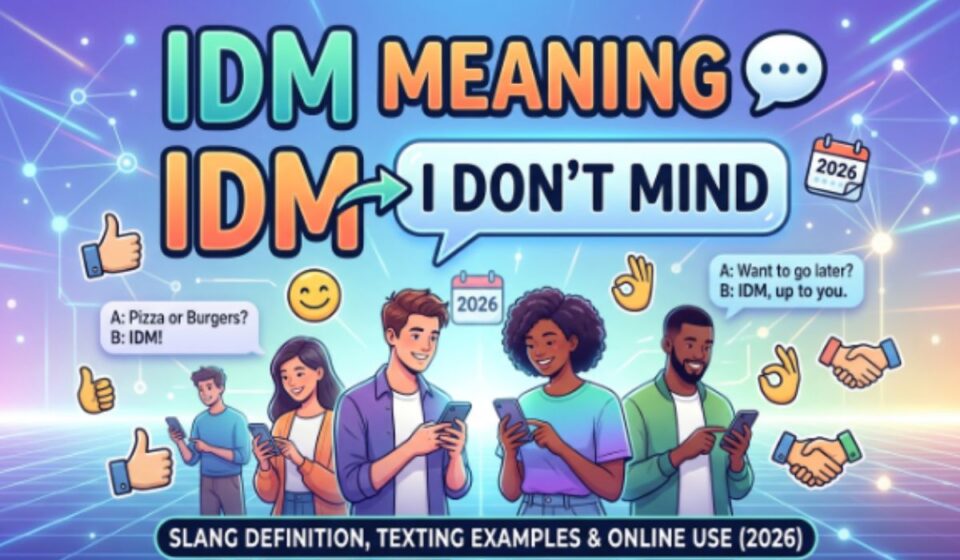

Quick Answer: IDM stands for “I Don’t Mind” — used to show you’re flexible or okay with either option someone suggests. It’s casual, friendly, and common across texting and social media.
⚡ Key Takeaways
- IDM meaning in text is short for “I Don’t Mind.”
- It shows flexibility, not indifference or laziness.
- IDM is different from IDK (I Don’t Know) and IDC (I Don’t Care).
- It’s widely used on WhatsApp, Snapchat, Instagram, Discord, and in gaming chats.
- Tone and context decide whether IDM sounds friendly, flirty, or neutral.
What Does IDM Mean in Text?
When someone texts “IDM,” they’re telling you they’re open to whatever you decide. It’s a quick, low-effort way to hand over the choice without sounding dismissive.
Understanding the IDM meaning in text matters because it’s easy to confuse with similar-looking abbreviations. Unlike IDK, which signals uncertainty, IDM signals agreement paired with flexibility.
IDM Full Form in Chat
The full form of IDM in chat is “I Don’t Mind.” That’s the core IDM meaning across almost every messaging app and social platform.
Simple examples
- “Pizza or burgers tonight?” — “IDM, you pick.”
- “Should we meet at 6 or 7?” — “IDM either time.”
- “Can I bring a friend?” — “IDM at all.”
📊 IDM Meaning at a Glance (Quick Reference Table)
| Abbreviation | Full Form | Tone | Common Use |
|---|---|---|---|
| IDM | I Don’t Mind | Friendly, flexible | Choosing between options |
| IDK | I Don’t Know | Neutral, unsure | Lack of information |
| IDC | I Don’t Care | Indifferent | No preference at all |
| NVM | Never Mind | Dismissive | Dropping a topic |
| WYD | What You Doing | Curious | Checking on someone |
Why Do People Use IDM?
People use IDM because it’s fast, easy to type, and gets the point across without a long reply. In casual texting culture, short abbreviations save time while still keeping the conversation warm.
Common reasons people say IDM
- To avoid sounding picky or demanding.
- To let the other person feel in control of the decision.
- To keep a conversation moving quickly.
- To show they’re genuinely fine with multiple outcomes.
What Does IDM Mean in Different Conversations?
The IDM meaning shifts slightly depending on context, though the base idea of flexibility stays the same.
1. IDM as “Either Option Is Fine”
Used when picking between two or more choices, like food, time, or location.
2. IDM as “You Can Choose”
Used when someone wants the other person to make the final call.
3. IDM as “That’s Okay”
Used as a soft way of agreeing to a plan or request.
4. IDM as “I Have No Strong Opinion”
Used when someone genuinely has no preference either way.
IDM Meaning in Texting Examples
Real conversation snippets make the IDM meaning easier to understand.
Example 1: Choosing Food
“Chinese or Italian tonight?” “IDM, both sound good.”
Example 2: Making Plans
“Movie night Friday or Saturday?” “IDM, whichever works for you.”
Example 3: Asking Permission
“Can I invite my sister too?” “IDM, the more the merrier.”
Example 4: Changing a Plan
“Can we push our call to 5pm?” “IDM, that works.”
Example 5: Letting Someone Choose
“Window or aisle seat?” “IDM, you pick.”
Is IDM the Same as “I Don’t Care”?
No. Though they can look similar in casual texting, they carry a different tone.
IDM
Suggests genuine flexibility and openness to any option offered.
I Don’t Care
Can sound indifferent or even a little dismissive, depending on tone.
IDM vs IDK: What’s the Difference?
IDM means being okay with any option. IDK means not having enough information to answer at all.
Example
“What time works?” — “IDK my schedule yet” shows uncertainty, while “IDM what time” shows flexibility.
IDM vs IDC: What’s the Difference?
IDM feels warmer and more engaged. IDC can feel colder, like the person genuinely has zero interest in the outcome.
Example
“Where should we eat?” — “IDM” sounds cooperative, while “IDC” can sound like the person isn’t invested in the plan.
IDM vs “Whatever”: What’s the Difference?
Both suggest flexibility, but they land differently depending on tone.
IDM
Reads as polite, casual, and cooperative in almost every context.
Whatever
Can sound sarcastic, annoyed, or dismissive depending on how it’s said.
Is IDM Rude?
IDM is not rude on its own. It’s typically read as an easygoing, agreeable response. Rudeness usually comes from tone, punctuation, or the surrounding conversation, not the abbreviation itself.
Is IDM Flirty?
IDM can carry a flirty tone when it’s used to show someone you’re happy to go along with their plans, especially paired with emojis.
Example
“Coffee or a walk this weekend? 😊” — “IDM, either works, just want to see you.”
IDM Meaning on Social Media Platforms
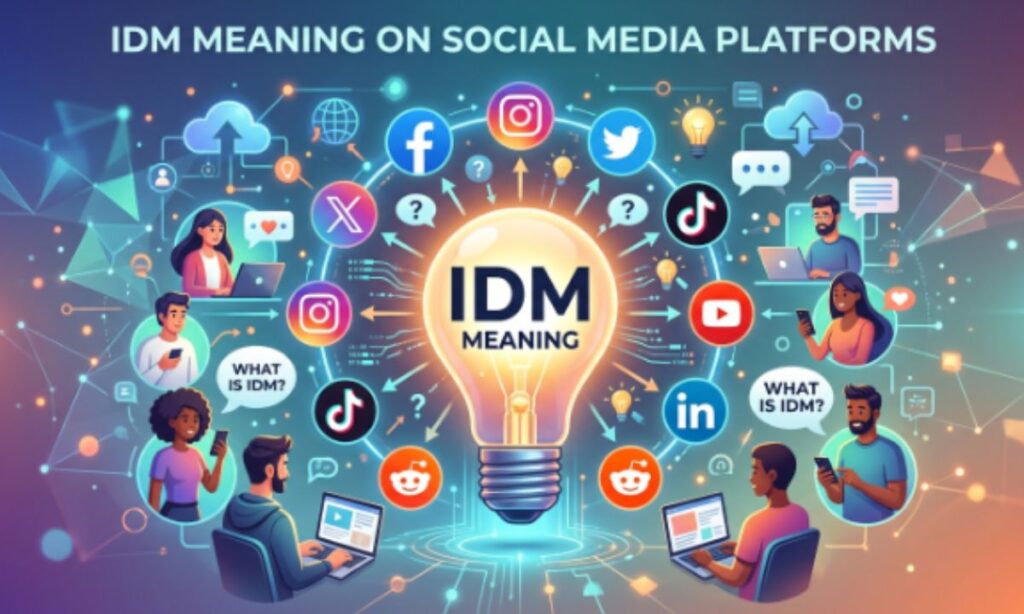
The IDM meaning stays consistent across platforms, though the vibe can shift slightly by app.
TikTok
Used in comments and captions to show agreement with a suggestion or trend idea.
Snapchat
Common in quick chat replies about plans or meetups.
Example
“Streaks or no streaks?” — “IDM lol.”
Shows up in DMs and comment replies when someone’s offering options.
Example
“Story or post?” — “IDM, your call.”
One of the most common places to see IDM, especially in group chats deciding plans.
Example
“Group call at 8 or 9?” — “IDM either.”
Discord
Used in gaming and community servers to agree with a suggestion quickly.
Example
“Voice or text chat?” — “IDM, whatever’s easier.”
IDM Meaning in Gaming
In gaming chats, IDM usually signals a player is fine with any role, map, or teammate choice.
Examples
- “IDM going support this round.”
- “IDM which map we pick.”
- “IDM if you want to lead.”
IDM Meaning in Dating Apps
On dating apps, IDM often signals openness to a suggested plan without sounding pushy about preferences.
Example
“Drinks or dinner for our first date?” — “IDM, whatever you’re comfortable with.”
IDM in Professional Messaging
IDM can appear in casual workplace chats, though it’s usually avoided in formal writing.
Casual work chat
“Zoom or Teams for the call?” — “IDM, either’s fine.”
Formal email
In formal emails, it’s better to write “I have no preference” or “Either option works for me” instead of IDM.
When Should You Use IDM?
Use IDM when you’re genuinely flexible and want to keep a conversation quick and easy.
Good example
Deciding between two casual plans with a friend.
Another good example
Replying to a low-stakes question where any answer works for you.
When Should You Not Use IDM?
Avoid IDM in situations that need a clear, thoughtful answer, or in formal settings.
Example
Responding to a work deadline question with IDM can come across as careless instead of flexible.
Common Mistakes People Make With IDM
Misreading the IDM meaning can lead to awkward replies.
Mistake 1: Thinking IDM Means IDK
IDM shows flexibility, not confusion or missing information.
Mistake 2: Assuming IDM Means “I Don’t Care”
IDM is warmer and more engaged than a flat “I don’t care.”
Mistake 3: Using IDM for Every Question
Overusing IDM can make someone seem like they never have opinions.
Mistake 4: Assuming It Is Flirty
Context and emojis matter; IDM alone isn’t automatically flirty.
Mistake 5: Ignoring Tone
The same three letters can read differently depending on punctuation and surrounding words.
How to Reply When Someone Says IDM
Knowing how to respond keeps the conversation flowing smoothly.
If they mean either option is fine
Just pick one and move forward with the plan.
If you want to confirm
Ask, “Are you sure? I can go with either.”
If the choice matters to you
Share your actual preference instead of guessing.
If you’re unsure what they mean
Ask a quick follow-up like, “Okay, but which do you actually prefer?”
Best Replies to IDM in a Conversation
Different tones fit different situations.
Casual
“Cool, let’s go with the first one.”
Friendly
“Okay, I’ll pick then, thanks for letting me decide!”
Playful
“IDM too, so now what do we do? 😂”
Flirty
“Aww, easygoing much? Let’s do the second option then.”
Clear
“Got it, I’ll go ahead and confirm the plan.”
Can IDM Have Other Meanings?
Yes. Outside of texting, IDM stands for different things depending on the field, so context always matters when reading it.
🌐 IDM Outside of Texting (Software, Trading & More)
- In software, IDM commonly refers to a popular download manager application.
- In business, IDM can stand for Identity Management, used in tech and security systems.
- In finance, IDM can appear as a ticker or trading-related abbreviation depending on the exchange.
- In academic or corporate settings, IDM may refer to Information and Data Management.
Is IDM a Positive or Negative Expression?
IDM is generally a positive, easygoing expression. It signals cooperation and flexibility rather than negativity, though tone and context can shift how it lands.
Frequently Asked Questions
What does IDM stand for in texting?
IDM stands for “I Don’t Mind,” showing flexibility with any option.
What does IDM mean in a chat?
It means the sender is okay with whatever the other person decides.
Is IDM the same as IDK?
No, IDK means “I Don’t Know,” while IDM means being flexible.
Is IDM rude?
No, IDM usually sounds agreeable unless the surrounding tone is harsh.
Does IDM mean “I don’t care”?
Not exactly; IDM feels warmer and more engaged than “I don’t care.”
Is IDM a slang word?
Yes, it’s a common texting abbreviation used across social platforms.
What does IDM mean from a girl or guy?
It carries the same meaning regardless of gender, though context can add a flirty tone.
Is IDM flirty?
It can be, especially when paired with emojis or playful wording.
What should I reply to IDM?
Pick an option, confirm the plan, or share your actual preference.
What is the opposite of IDM?
A strong preference reply, like “I really want the first option,” is the opposite of IDM.
Conclusion
The IDM meaning boils down to one simple idea: flexibility. Whether you’re picking a restaurant, setting a call time, or replying in a group chat, IDM is a quick, friendly way to say you’re happy either way.
Once you know the IDM meaning and how it differs from IDK, IDC, and “whatever,” you’ll never second-guess a text again. Next time IDM lands in your inbox, you’ll know exactly how to reply.