
A coworker pings you on Slack: “Can you loop in the SME on this?” Later that day, a news article says “SMEs need more access to funding.” Same three letters, two different worlds.
The SME meaning depends on where you see it. This guide explains both common meanings, shows you how to tell them apart, and clears up the mix-ups with similar terms like SMB.
Quick Answer
SME most often means “Small and Medium Enterprise,” a business size category. It also means “Subject Matter Expert,” a person with deep knowledge of a topic. Business and funding talk points to the first meaning, and project or team talk points to the second.
Key Takeaways
- SME means “Small and Medium Enterprise” in business and economics.
- SME also means “Subject Matter Expert” in projects, training and consulting.
- The SME meaning depends on context, so check the topic first.
- Both versions of the SME meaning are formal and professional.
- The EU defines an SME as a business with under 250 employees.
- SMB never refers to a person, but SME can.
- SME is a formal, professional term in both meanings.
What Does SME Mean?
The SME meaning splits into two main uses. One describes a type of company. The other describes a type of person.
SME = “Small and Medium Enterprise”
In this sense, SME is a category of business. It covers companies that are smaller than large corporations but bigger than tiny micro businesses. Governments, banks and trade bodies use it to talk about the backbone of many economies. This is the most common SME meaning in news and policy.
SME = “Subject Matter Expert”
In this sense, SME is a person who knows a topic in depth. Teams call on an SME when they need accurate, specialized advice. Example: “We need an SME on tax law for this project.” This SME meaning is the one you will hear most often at work.
How to Tell Which Meaning Is Intended
Context settles it almost every time. Use this quick guide.
| Clue | Small and Medium Enterprise | Subject Matter Expert |
|---|---|---|
| Topic | Funding, taxes, growth, policy | Projects, training, consulting |
| Phrase | “SMEs in Europe” | “Ask the SME” |
| Number | Plural, as a group | Singular, a person |
| Setting | News, reports, government | Slack, Teams, meetings |
If the sentence talks about a group of companies, it is the business meaning. If it talks about one person you can ask a question, it is the expert meaning. When you cannot tell, a short “Do you mean the business type or the expert?” clears it up.
SME as “Small and Medium Enterprise”
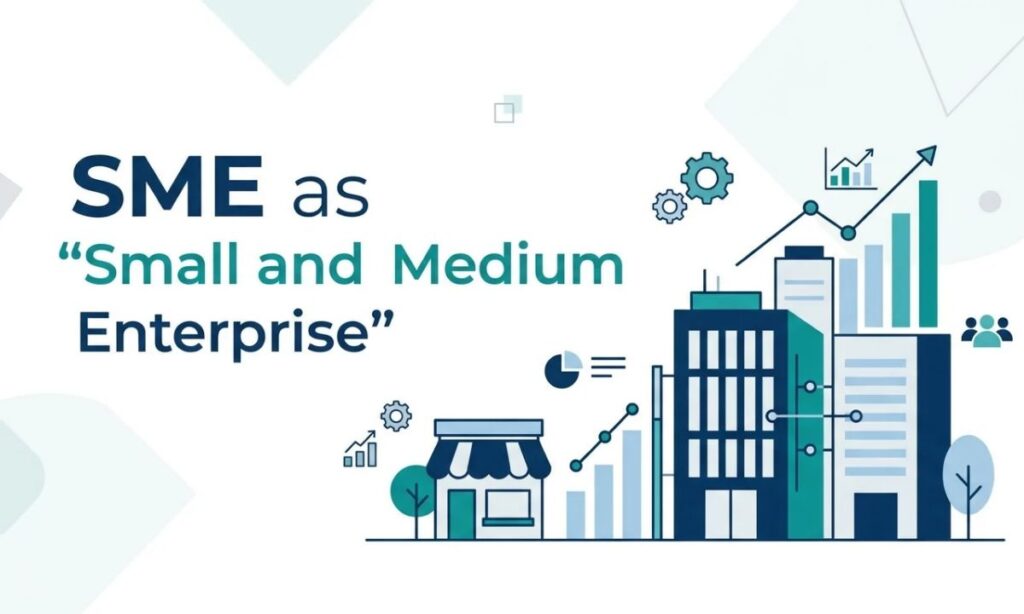
The Official EU Definition (Employee Count, Turnover)
The European Union gives a clear definition. An SME has fewer than 250 employees. It also has annual turnover of up to €50 million, or a balance sheet total of up to €43 million.
The EU then splits SMEs into tiers:
| Category | Employees | Annual Turnover |
|---|---|---|
| Medium-sized | Under 250 | Up to €50 million |
| Small | Under 50 | Up to €10 million |
| Micro | Under 10 | Up to €2 million |
Other countries set their own limits, so the SME meaning in law varies by region.
Why This Classification Matters (Funding, Regulation, Tax)
Size labels affect real decisions. The SME meaning in a legal or policy setting can change what a business receives or must follow.
- Funding: many grants and loan programs are open only to SMEs.
- Regulation: smaller firms may face lighter reporting rules.
- Tax: some regions offer reduced rates or credits to SMEs.
That is why business owners care about the label.
SME as “Subject Matter Expert”
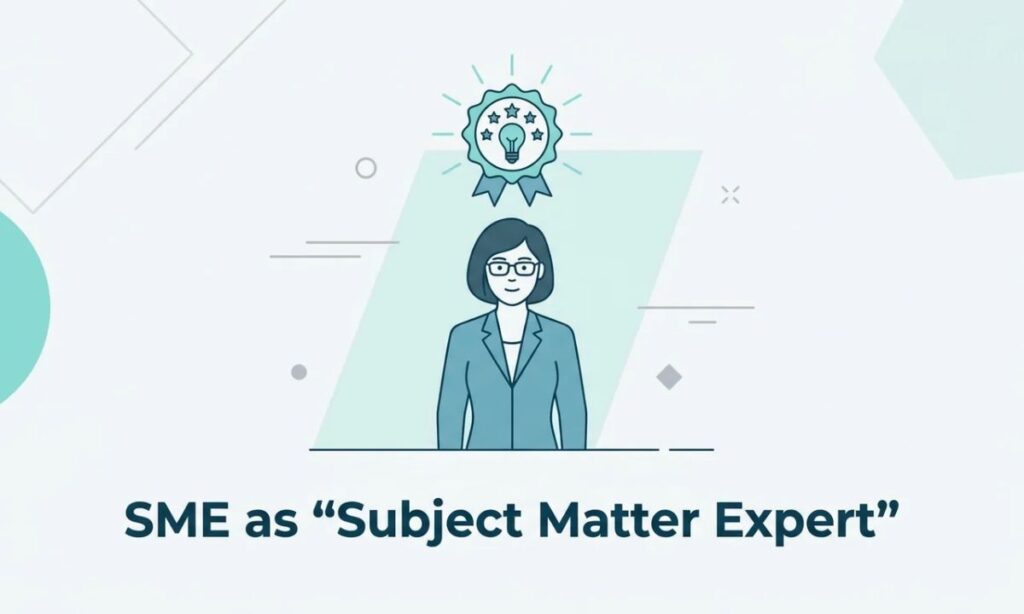
What a Subject Matter Expert Actually Does
An SME shares deep, reliable knowledge. They review content, answer technical questions, check facts and guide decisions. They do not need to manage a team. Their value is accuracy.
Typical tasks include:
- Reviewing a training course for errors
- Explaining a complex process to the team
- Validating a product design or policy
- Advising on risks and best practices
Where You’ll See the Term Used (Projects, Training, Consulting)
The SME meaning as an expert shows up in three common places:
- Projects: a project manager asks an SME to confirm technical details.
- Training: course designers work with an SME to build accurate lessons.
- Consulting: firms bring in an SME for specialized industry knowledge.
SME vs. SMB: What’s the Difference?
SME and SMB look alike, but the SME meaning is broader. SMB means “small to medium business.” It refers only to companies. It never describes a person.
| Term | Stands For | Refers To |
|---|---|---|
| SME | Small and Medium Enterprise, or Subject Matter Expert | A business category or a person |
| SMB | Small to Medium Business | Businesses only |
So if you see “the SMB said,” it is a company. If you see “the SME said,” it could be a company or an expert, so check the context.
Real-Life Examples
Work Chat/Slack Example (Subject Matter Expert)
Priya: The compliance section looks shaky.
Dan: Let’s get an SME to review it.
Priya: Agreed. I’ll ask Maria. She’s our SME on data privacy.
Dan: Perfect. Loop her into the thread.
Business/Funding Context Example (Small and Medium Enterprise)
“The new program offers low-interest loans to SMEs in the manufacturing sector. Businesses with fewer than 250 employees can apply before the end of the quarter.”
Here the SME meaning is a size category, and the clue is the plural form and the funding topic.
SME Meaning by Context
In Business and Economics
In economics, SMEs are often described as engines of jobs and innovation. Reports track how many SMEs exist, how fast they grow and how they access credit.
In Project Management and Consulting
On projects, the SME meaning is the go-to person for specialized knowledge. Teams list SMEs in project plans, and consultants often act as SMEs for their clients.
In Casual Work Chat (Slack, Teams, WhatsApp Groups)
In casual work chat, people use SME as quick shorthand. “Who’s the SME for this?” means “Who knows this topic best?” It is informal in tone, but the term itself is still professional.
Other Related Business Classifications
SMM (“Small and Medium-Sized Manufacturers”)
SMM refers to small and medium-sized manufacturers, which are SMEs that make physical products. You will see it in industry reports and trade programs focused on factories and production.
Micro, Small, and Medium Enterprises (the Full Tiered System)
SME sits inside a larger system. The full set is often called MSME, meaning micro, small and medium enterprises. Micro businesses are the smallest tier, usually with fewer than 10 employees. Many countries, including India and several in Asia and Africa, use the MSME label in official policy.
Common Misunderstandings About SME
Assuming It Only Refers to Business
Many people know SME only as a company type, but it has a second side. In project settings, though, the SME meaning is a person. Missing this can lead to confusion in meetings.
Confusing It With “Freelancer” or “Startup”
An SME is not the same as a freelancer or a startup. A freelancer is a self-employed worker. A startup is a young company built to grow fast. An SME is defined by size, not age or work style. A startup can be an SME, but not every SME is a startup.
Using It Too Casually in Formal Reports
Because SME has two meanings, a formal report should define the SME meaning the first time. Write “Small and Medium Enterprise (SME)” or “Subject Matter Expert (SME)” before using the short form. This keeps readers on the same page.
Is SME a Formal Term?
Yes. Unlike many slang terms, SME is professional in both meanings. There is no casual, texting-only version to avoid. You can use it in reports, emails, project plans and policy papers.
The only caution is clarity. Since the SME meaning changes with context, spell it out once in formal writing.
Why SMEs (Subject Matter Experts) Matter in a Team
A good SME improves the quality of everything the team produces. Their value shows up in several ways:
- Accuracy: they catch errors before they reach customers.
- Speed: teams spend less time guessing and searching.
- Trust: clients trust work that an expert has reviewed.
- Learning: they share knowledge, so others grow faster.
Without an SME, teams often rely on guesses and old habits. With one, decisions rest on real expertise. That is why project managers name an SME early and keep them involved through review.
Frequently Asked Questions
What does SME stand for in business?
In business, SME stands for Small and Medium Enterprise, a company size category.
What does SME mean in a job role?
In a job role, SME means Subject Matter Expert, a person with deep knowledge of a topic.
How do I know which meaning applies?
Check the topic. Funding and policy point to enterprises, while projects and training point to experts.
Is an SME the same as a startup?
No. SME describes size, while a startup describes a young, fast-growing company.
Can one person be an SME?
Yes. In the expert meaning, one person can be an SME.
Why are SMEs important?
Small and medium enterprises create jobs and drive growth, and subject matter experts keep work accurate.
Is SME a formal term?
Yes. It is formal and professional in both meanings.
What’s the difference between SME and SMB?
SMB means “small to medium business” and only refers to companies, while SME can also mean an expert.
Conclusion
The SME meaning comes down to context. It can mean Small and Medium Enterprise, a business size category with clear EU limits. It can also mean Subject Matter Expert, a person whose knowledge your team relies on.
Check the topic, define the term in formal writing and remember that SMB never refers to a person. The next time you see SME in a chat or a report, you will know exactly which one it is.