
You find the word “parer” in a recipe, a crossword clue or a dictionary list, and you pause. Is it a typo for “paper”? A French word? A kitchen tool? The truth is that it can be a few of those, depending on the language and the setting.
The parer meaning is simple in English, but similar-looking words in French, Catalan and Spanish cause plenty of mix-ups. This guide covers the definition, the origin, real examples and the look-alikes you should not confuse it with.
Quick Answer
In English, a parer is a tool or a person that pares, meaning one that trims away an outer layer, such as the skin of a fruit or the edge of a piece of leather. Most often it means a paring knife or a vegetable peeler. In Irish English, it can also mean a pencil sharpener.
Key Takeaways
- A parer is “one who pares” or a tool that pares.
- The word comes from “pare” plus the suffix “-er.”
- It most often appears in kitchen contexts, such as a paring knife or fruit parer.
- In Irish English, a parer can be a pencil sharpener.
- The parer meaning is not the same as French “parer” or Spanish “parar.”
- It is a fairly uncommon word in everyday conversation.
- The parer meaning changes with language, so check the setting first.
What Does “Parer” Mean?
The English parer meaning rests on the verb “pare,” which means to trim or peel away an outer layer in thin pieces. A parer is whatever does that job. It can be an object or a person.
A Paring Knife
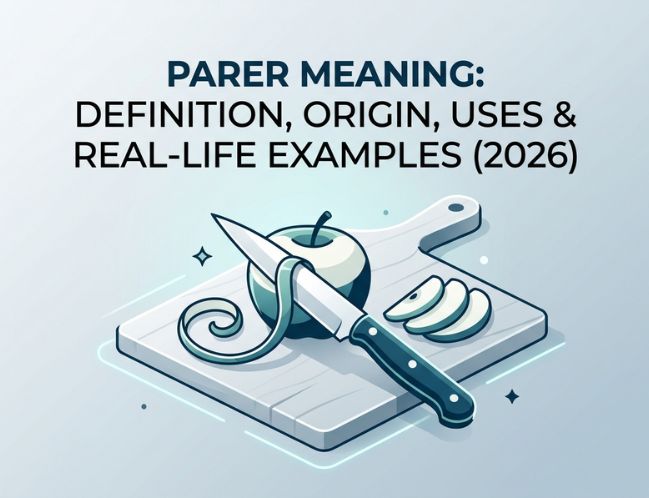
The most familiar use is a small, sharp kitchen knife made for peeling and trimming. People sometimes call it a parer for short. Cooks use it to peel apples, trim vegetables and remove blemishes from fruit.
“One Who Pares”
The second use is a person. Dictionaries define a parer as “one that pares.” That could be someone who trims leather, shaves wood or cuts nails. The role depends on the work, but the idea is the same: removing a thin layer with care. This “one who pares” parer meaning is rare today, yet it remains in every major dictionary.
Where Does the Word “Parer” Come From?
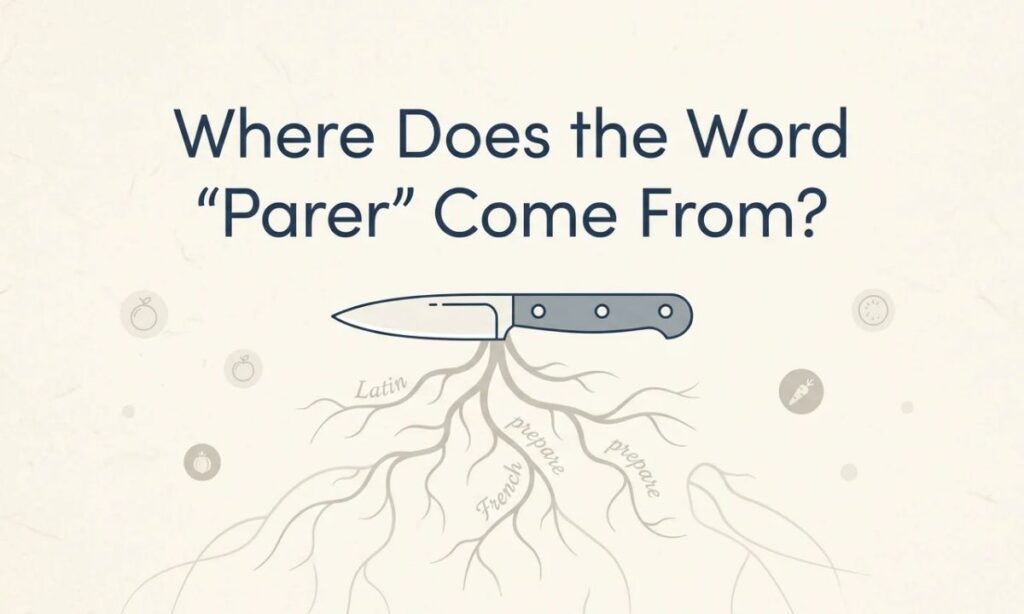
The origin is easy to follow, and it explains the modern parer meaning well. “Parer” is built from “pare” and the agent suffix “-er,” which turns a verb into the name of the doer, just as “bake” becomes “baker.”
The verb “pare” came into English through Old French parer, meaning to prepare or trim. That goes back to Latin parāre, meaning to prepare or make ready. Over time, the sense narrowed in English from “prepare” to “trim away,” especially for food and materials. Early cooks and craftsmen used the verb long before the noun became common.
So the parer meaning carries a quiet history. A parer prepares something by removing what you do not need.
Parer as a Kitchen Tool
What a Paring Knife Is Used For
A paring knife is small, usually three to four inches long, with a thin, sharp blade. It gives you control for delicate work, which is why the kitchen parer meaning is the one most people know.
Common tasks include:
- Peeling apples, potatoes and other produce
- Trimming stems and removing seeds
- Cutting garlic, shallots and small fruit
- Removing blemishes or bruised spots
Vegetable and Fruit Parers
Some peelers are also called parers, especially older or regional names for hand tools that shave off skin. A fruit parer may be a simple hand blade or a crank-style device that peels an apple in one long spiral. Antique versions are popular with collectors, and the parer meaning on old tool labels is almost always about peeling.
| Tool | Best For | Typical Style |
|---|---|---|
| Paring knife | Detailed trimming and peeling | Short fixed blade |
| Vegetable parer | Removing thin skin from produce | Swivel or straight blade |
| Apple parer | Peeling apples quickly | Crank-style device |
Parer as “One Who Pares” (A Person)
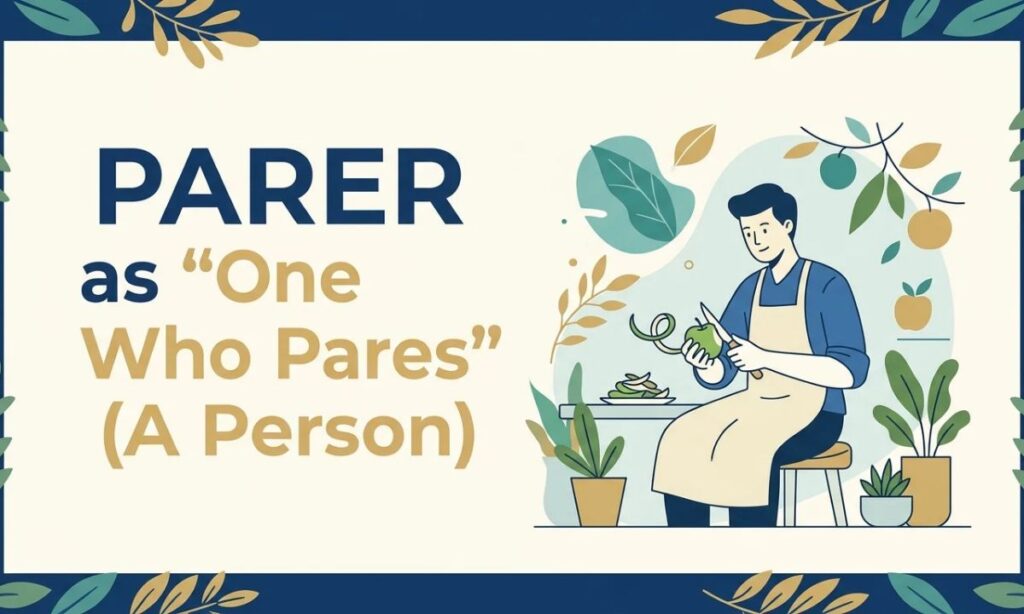
Because of the “-er” ending, parer can name a worker. This use is rare today but still appears in dictionaries and in trade history.
A Leather Parer (Bookbinding)
In leatherwork and bookbinding, paring means shaving the edges or thinning leather so it folds neatly over a book cover or lies flat at a seam. A person who does this is a leather parer, and the work needs a steady hand. In this trade, the parer meaning is about precision, since a slip can ruin a whole piece of leather.
A Manicurist Who Trims Nails
Someone who trims or pares nails can also be called a parer in the loose sense. Modern speech usually says “manicurist” or “nail technician” instead, so this use sounds old-fashioned.
“Parer” as a Pencil Sharpener (Irish English)
In Irish English, “parer” can be an informal word for a pencil sharpener. The logic fits. A sharpener pares wood away from the pencil to reveal a fresh point.
Example: “Pass me the parer, my pencil is blunt.”
This regional use shows how Irish speech keeps old words alive.
This is a regional and informal use, so you will mainly hear it in Ireland. Outside that setting, most English speakers will say “pencil sharpener.” Knowing this regional parer meaning can save you some confusion if you read Irish writing or talk with Irish speakers.
Don’t Confuse “Parer” With These Similar-Looking Words
Here is the most important warning. Several languages have a word spelled “parer,” and none of them behave like the English noun.
French “Parer” (To Adorn / To Dodge)
In French, parer is a verb. It can mean to adorn or decorate, and it can also mean to ward off or dodge, as in parrying a blow. It shares a distant ancestor with English “pare,” but the sense is different.
Catalan “Parer” (Opinion)
In Catalan, parer is a noun meaning an opinion or point of view. A Catalan speaker might use it to say what they think about something. It has no link to peeling or trimming.
Spanish “Parar” (To Stop)
Spanish uses parar, spelled with two a’s, meaning to stop. It is a different word from “parer,” but the spelling is close enough that learners mix them up. If you see “parar” on a sign or in a sentence, think “stop,” not “peel.”
| Word | Language | Meaning |
|---|---|---|
| Parer | English | Tool or person that pares |
| Parer | French | To adorn or to ward off |
| Parer | Catalan | Opinion |
| Parar | Spanish | To stop |
The parer meaning in English is only one of several, so check the language before you translate. Translation apps often miss this, so read the sentence around the word.
How to Pronounce “Parer”
In English, “parer” is pronounced roughly “PAIR-er,” with stress on the first syllable. It sounds like “pair” plus “er.”
Sound is another clue to the parer meaning, since the look-alikes sound different:
- French parer: roughly “pah-RAY”
- Spanish parar: roughly “pah-RAR,” with a rolled or tapped r
- Catalan parer: roughly “puh-RAY” in many dialects
If you say “PAIR-er” in a kitchen, people will understand you. If you say “pah-RAY” in English, they may think you are speaking French.
Is “Parer” a Common Word?
Honestly, no. The parer meaning is not part of daily talk, and the word is fairly uncommon in everyday conversation. Most people say “peeler” or “paring knife” instead. You are most likely to meet the word in cooking guides, tool catalogs, old trade texts and dictionaries.
That rarity is one reason the parer meaning puzzles people, even native English speakers. Without frequent use, it is easy to forget or mistake for something else. Still, it is a legitimate English word with a clear definition.
Related Words
“Pare” (the Verb)
“Pare” means to trim off the outer layer or to reduce something gradually. You can pare an apple, and you can also pare down a budget. Example: “We need to pare back our costs this year.”
“Paring Knife”
A paring knife is the tool most closely tied to the word. It is the small kitchen knife for peeling and trimming, and it is the easiest way to remember the parer meaning. If you picture someone peeling an apple, you have the idea.
“Parergon” (an Unrelated, Separate Word)
“Parergon” looks similar but is a separate term. It comes from Greek and refers to something secondary or supplementary to a main work, such as a decorative frame around a painting. It is used in philosophy and art theory. It has no connection to “pare” or “parer.”
Frequently Asked Questions
What does “parer” mean in simple words?
A parer is a tool or a person that trims away an outer layer, like a paring knife or a fruit peeler.
What is a parer tool?
A parer tool is a small blade or peeling device used to remove skin or thin layers from food or materials.
Can “parer” describe a person?
Yes. It can mean “one who pares,” such as a leather worker who thins or trims leather.
What’s the difference between “pare” and “cut”?
To pare is to remove a thin outer layer carefully, while to cut is to divide something in general.
Is “parer” the same as the Spanish word “parar”?
No. “Parar” is Spanish for “to stop,” and it is a separate word from the English “parer.”
Is “parer” a commonly used word?
No. It is uncommon in daily speech and mostly appears in kitchen, trade and dictionary contexts.
Conclusion
The parer meaning in English is straightforward: a tool or a person that pares, or trims away a thin outer layer. It comes from “pare” plus “-er,” and it traces back through Old French to Latin parāre. It most often means a paring knife or fruit peeler, and in Irish English it can mean a pencil sharpener.
Watch out for the look-alikes in French, Catalan and Spanish, and do not mix it up with “parergon.” Next time you see the word, check the language and the setting, and you will know exactly what it means.