
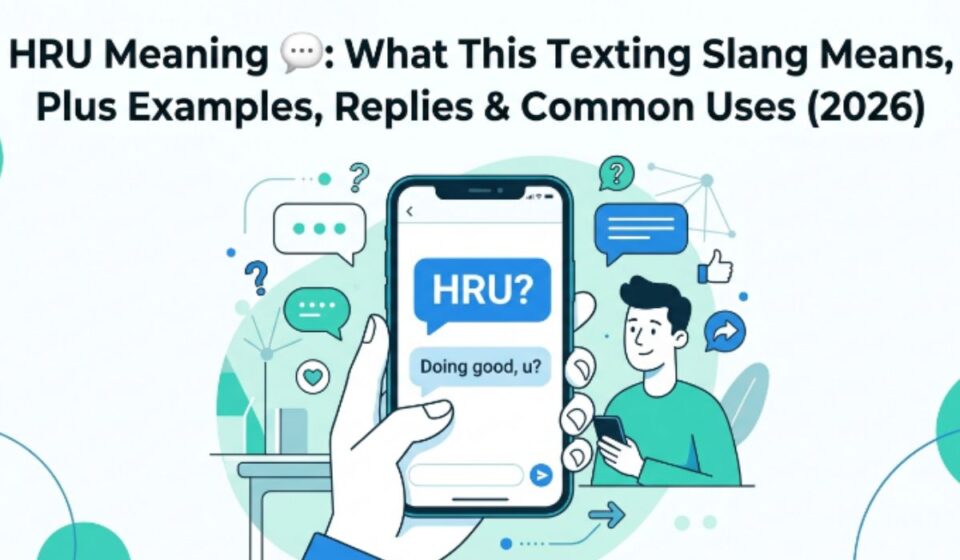

Quick Answer: HRU stands for “How Are You,” a quick, casual way to check in on someone in a text. It’s friendly by default and one of the most common conversation starters in texting.
If you’ve ever opened a chat and seen someone type “hru?” out of nowhere, you’re not alone. It looks cryptic the first time, but once you know the HRU meaning, you’ll spot it everywhere: DMs, group chats, gaming lobbies, and comment sections.
This guide breaks down the full HRU meaning, how to use it naturally, and how to reply without sounding awkward.
⚡ Key Takeaways
- The HRU meaning is simple: “How Are You,” a shortened, informal check-in question.
- It’s used to start or continue a casual conversation, not to demand deep information.
- HRU is neutral and friendly by default, though tone shifts depending on platform, punctuation, and who’s sending it.
- It’s common on texting apps, Snapchat, Instagram, WhatsApp, TikTok, and gaming chats.
- HRU has a rare technical use (electrical/medical fields), but 99% of the time it’s just texting slang.
- Best reply style: short, honest, and a question back, like “good, hru?” or “not bad, u?”
What Does HRU Mean in Text?
In texting and online chat, the HRU meaning is simple: it’s an acronym that stands for “How Are You.” It swaps the words “are” and “you” for their sound-alike letters, R and U, which is why it’s written as a single, compact string instead of three separate words.
People use HRU the same way they’d use the full phrase in speech, as a greeting, a conversation opener, or a way to check on someone’s mood or day. It’s informal, so it fits best in casual texting rather than formal writing.
Example
Mia: hey! hru? Sam: pretty good, just got out of class. hru?
⚠️ Does HRU Mean “Who Are You”? (Common Mix-Up)
No, that’s a common misread, especially for people new to texting slang. “Who are you” is usually written as WRU or spelled out fully. The real HRU meaning almost always points to “How Are You,” and context (a greeting, not a question about identity) makes that clear.
Why People Use HRU
Texting rewards speed, and HRU is simply faster to type than the full phrase. But it’s not only about saving keystrokes:
- Speed: three letters instead of three words.
- Casual tone: it feels relaxed rather than formal or stiff.
- Habit: it’s been part of internet and SMS culture for years, so it comes naturally.
- Low pressure: it invites a reply without demanding a detailed one.
Other Meanings of HRU
Outside of texting, the HRU meaning occasionally shifts in specialized fields. Context always makes it obvious which one applies.
HRU in Medical Terms
In some clinical or nursing shorthand, HRU can refer to “High-Risk Unit” or appear in health-related abbreviations depending on the institution. This use is limited to professional documentation, not everyday conversation.
HRU in Electrical/Technical Contexts
In electrical and industrial settings, HRU can stand for things like a “Hydraulic/Heat Recovery Unit” in certain equipment manuals. Again, this has nothing to do with texting, it’s purely industry jargon.
HRU Meaning on Social Media Platforms

The core HRU meaning stays the same everywhere, but the vibe shifts slightly depending on the app.
Snapchat
Often paired with a Snap or streak message, a quick, low-effort way to keep a conversation or streak alive.
Common in DMs after a story reply or comment, used to turn a one-off interaction into an actual conversation.
Used between friends and family as a simple daily check-in, sometimes replacing “how’s it going.”
TikTok
Shows up in comments or DMs after watching someone’s video, functioning as a friendly icebreaker.
Gaming Chats
In lobbies or party chats, HRU is a quick social check-in between matches, casual, not usually about the game itself.
HRU in Real-Life Chat Examples
Example 1: Simple greeting
“hru? haven’t talked in a while!”
Example 2: Friendly conversation starter
“just saw your post, looks fun! hru btw?”
Example 3: Gaming chat
“gg that round. hru, tired or want another game?”
HRU vs Full Phrase “How Are You”
Comparing the HRU meaning side by side with the full phrase makes the difference in tone and use case easy to see.
| Feature | HRU | “How Are You” |
|---|---|---|
| Tone | Casual, informal | Neutral to formal |
| Best used in | Texting, DMs, social apps | Emails, professional chats, spoken conversation |
| Speed | Very fast to type | Slower |
| Suitable for strangers/formal contacts | Not ideal | Yes |
| Common platforms | SMS, Snapchat, Instagram, gaming | Anywhere, including in person |
Is It Rude to Text “HRU” Instead of Writing It Out?
No, it’s not rude. Once you understand the HRU meaning, it’s clear this is standard texting shorthand between friends, peers, and casual contacts. It can feel too informal for a boss, teacher, or someone you don’t know well, so it’s worth matching the tone of the person you’re texting.
HRU vs HBU (Common Confusion)
These two often appear together, but they mean different things:
- HRU = “How are you?” the opening question.
- HBU = “How about you?” the follow-up question, usually asked back after answering.
Typical exchange: “I’m good, hbu?” answers a question that was likely started with an HRU.
Is HRU Rude or Polite?
HRU is polite in casual settings, it shows interest in the other person. It only reads as impolite if it’s sent with no greeting, no punctuation, and no follow-up, which can come across as low-effort or abrupt.
Is HRU Flirty?
HRU itself is neutral, not inherently flirty. Tone comes from context: emojis, timing, and the relationship between texters can turn a plain HRU into something flirtier, but the phrase alone is just a check-in.
Common Misunderstandings About HRU
Even with a clear HRU meaning, mix-ups still happen. The most frequent ones:
- Assuming it’s rude: it’s usually just casual, not dismissive.
- Confusing it with “who are you”: context almost always clears this up.
- Reading too much into tone: a bare “hru” from someone you know well is rarely a big deal.
- Using it in formal messages: this is where it actually causes friction.
How to Reply to HRU
A good reply usually does two things: answers briefly, then asks back. Some simple options:
- “good, hru?”
- “not bad, u?”
- “pretty busy today, hbu?”
- “same as always, hru though?”
What to Say Instead of “Good, HRU?” (Better Replies)
If you want to sound a little more original than the default reply, try:
- “Doing well, thanks for asking, how about you?”
- “Can’t complain! What’s up with you?”
- “Kind of a long day, honestly. You?”
- “All good here, what’s new with you?”
When NOT to Use HRU
- In professional emails or messages to a boss/client.
- With teachers, elders, or authority figures you don’t text casually.
- In serious conversations, like checking in after bad news, a fuller message shows more care.
- In first messages to strangers, where it can feel too casual or low-effort.
Cultural and Online Usage Differences
HRU is widely understood in English-speaking texting culture, especially among younger users in the U.S., U.K., Canada, and Australia. In more formal cultures or workplace-heavy messaging norms, people tend to lean toward the full phrase instead of the abbreviation.
Common Mistakes with HRU
- Typing “hur” or “hur” by accident instead of “hru.”
- Using it in a message that needs a serious or formal tone.
- Sending it as a stand-alone message with no other context, which can feel abrupt.
- Assuming everyone knows it, older or less online contacts may not.
Related Internet Slang You Should Know
- HBU: How about you?
- WYD: What are you doing?
- SUP: What’s up?
- GM/GN: Good morning / Good night.
- BRB: Be right back.
Why HRU Became Popular
The HRU meaning we use today grew out of the early SMS era, when character limits and slow keypad typing pushed people to shorten common phrases.
As texting moved to smartphones and social apps, the habit stuck, not because it’s necessary, but because it fits the fast, informal rhythm of digital conversation.
Frequently Asked Questions
What does HRU mean in chat?
The HRU meaning in chat is “How Are You,” a quick, casual way to check in on someone.
Is HRU still used today?
Yes, it’s still widely used in texting, DMs, and gaming chats in 2026.
Can I use HRU with strangers?
It’s fine for casual online contacts, but a fuller greeting works better for total strangers.
Is HRU American slang?
It’s popular in the U.S. but used broadly across English-speaking texting culture worldwide.
Is HRU appropriate to text a teacher, boss, or elder?
No, it’s too casual for formal or professional messages; spell out the full phrase instead.
What does HRU mean from a girl or guy specifically?
The meaning doesn’t change by gender, it’s a neutral check-in, with tone depending on context, not the sender’s gender.
What’s a good one-word reply to HRU?
“Good,” “fine,” or “same” all work as quick, natural one-word replies.
Conclusion
At its core, the HRU meaning is simple: a small piece of texting shorthand with one job, asking “How are you?” quickly and casually.
It works best between friends, family, and casual online contacts, and it’s easy to reply to with a short answer and a question back.
Now that you know the full HRU meaning, save the formal phrase for formal messages, and you’ll never misuse HRU again.