
If you’ve ever heard someone say “I agree, but with one caveat,” you already have a rough sense of what this word does. This guide breaks down the full caveat meaning, where the word comes from, and how to use it correctly in writing, conversation, and legal or professional contexts.
Quick Answer
A caveat is a warning, condition, or qualification attached to a statement, agreement, or piece of advice. In short, the caveat meaning is: “this is true, but only under certain conditions.” It signals that something needs extra attention before you accept it fully.
What Does Caveat Mean?
In everyday English, the caveat meaning centers on one idea: a stated exception or warning that limits or qualifies something you just said.
- As a noun: “There’s one caveat to this plan.”
- In a sentence: “I recommend this restaurant, with the caveat that it’s expensive.”
Essentially, a caveat softens a statement by flagging a condition, risk, or limitation the listener should keep in mind.
Where Does the Word “Caveat” Come From?
The caveat meaning traces directly back to Latin. The word comes from cavēre, meaning “to beware” or “to take care.” It entered English in the 1530s to 1540s as a legal term, literally translating to “let him beware.”
Originally, it was used in formal and legal documents to warn a party that a claim or action needed careful attention before proceeding. Over time, it moved beyond strict legal use and became common in everyday English to describe any warning or condition attached to a statement.
“Caveat Emptor” and Other Famous Caveat Phrases
Several Latin phrases built on “caveat” are still widely used today.
| Phrase | Literal Meaning | Common Use |
|---|---|---|
| Caveat emptor | Let the buyer beware | Warns buyers to check goods carefully before purchase |
| Caveat lector | Let the reader beware | Warns readers to verify information before trusting it |
| Caveat venditor | Let the seller beware | Reminds sellers they can be held responsible for what they sell |
“Caveat emptor” is by far the most common of these, often used in sales, real estate, and consumer contexts to mean the buyer takes on the risk of the purchase.
What Does “With One Caveat” Mean?
This is one of the most common everyday uses of the word. “With one caveat” simply means “with one exception or condition attached.” For example: “You can borrow my car, with one caveat, fill up the tank before you return it.” It signals that overall approval or agreement, but under a specific condition.
Caveat Meaning by Field
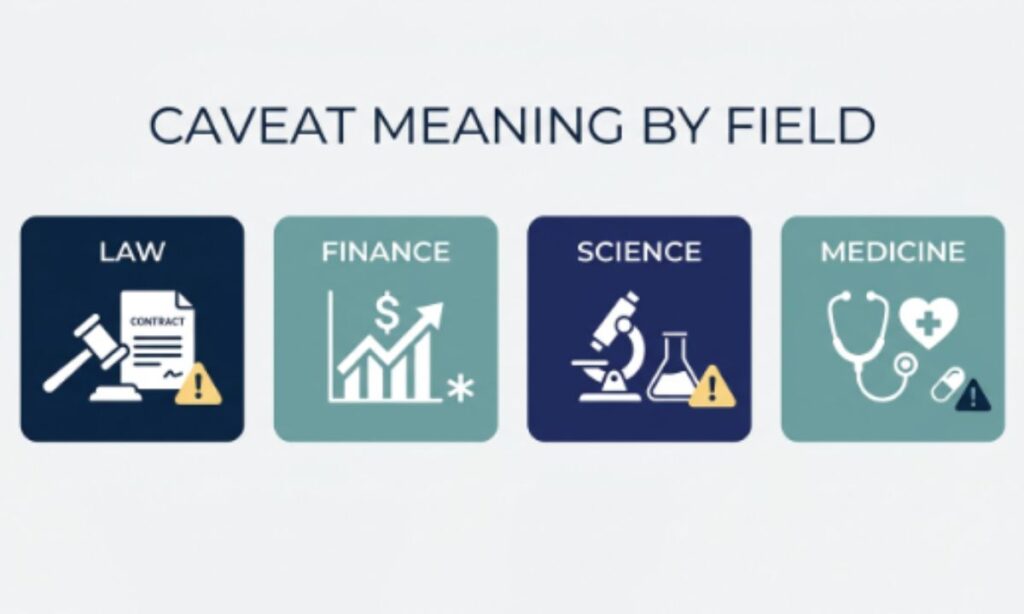
Caveat Meaning in Law
In law, a caveat is a formal notice filed with a court asking it to pause a proceeding until the person filing has been heard. It essentially puts decision-makers on alert that a dispute exists.
Caveat Meaning in Probate
In probate, a caveat is filed to stop a will from being formally approved (probated) until the person filing it has a chance to contest it, often due to concerns about the will’s validity.
Caveat Meaning in Property Law
Under Torrens title and similar property registration systems, a caveat is a legal notice lodged against a property title, preventing changes to that title until a competing claim or interest is resolved.
Caveat Meaning in Business
In contracts and business deals, a caveat often appears as a clause limiting liability or flagging a condition under which an offer, price, or agreement applies.
Caveat Meaning in Statistics
In research and data reporting, a caveat is a stated limitation, such as a small sample size or margin of error, that qualifies how confidently the results should be interpreted.
Caveat Meaning in Medical Contexts
In medical or health writing, a caveat usually flags a risk or condition tied to treatment or advice. For example, a doctor might recommend a medication “with the caveat that it shouldn’t be combined with alcohol.” Here, the word points to a safety condition rather than a legal one.
How Context Changes the Meaning
In Recommendations
A caveat often softens praise: “Great product, caveat being it’s pricey.”
In Agreements
It marks a condition attached to consent: “I’ll sign, with the caveat that the deadline is extended.”
In Factual Statements
It limits how broadly a fact applies: “The results are accurate, with the caveat that the sample size was small.”
In Casual Conversation
It can simply mean “one thing to keep in mind”: “I loved the trip, one caveat, the weather was rough.”
Real Conversation Examples
Friends
A: “You should watch that show.” B: “Any caveats?” A: “Just that the first two episodes are slow.”
Workplace
A: “We can hit that deadline.” B: “With one caveat, we need another developer on the team.”
Social Media
A: “This laptop is amazing, caveat: the battery life could be better.”
How to Use “Caveat” Correctly
“Caveat” is most often used as a noun, typically after phrases like “with the caveat that…” or “one caveat being…”. In more casual or modern usage, especially in business speech, it’s increasingly used as a verb too, as in “I want to caveat that statement,” meaning to attach a qualifying condition to it.
Is Using the Word “Caveat” Too Formal or Pretentious?
Not inherently, but it can sound formal or legalistic in very casual conversation. In workplace, academic, or legal settings, it reads as precise and professional. Among close friends texting casually, simpler words like “but” or “heads up” often fit better.
When to Use — and When to Avoid — “Caveat”
Use it when:
- Writing formal emails, reports, or agreements
- Making a recommendation that comes with a condition
- Explaining a legal or contractual limitation
Avoid it when:
- Texting casually with friends, where “but” feels more natural
- You want to sound approachable rather than formal
- A simpler word would communicate the same point faster
Common Mistakes About Caveat
- Treating “caveat” as a synonym for “complaint” (it’s a condition, not a criticism)
- Assuming it’s always a legal term (it’s common in everyday speech too)
- Overusing it in casual writing, which can sound stiff
- Confusing it with “disclaimer,” which is broader and less specific
Similar Words to Caveat
| Word | Meaning |
|---|---|
| Caution | A general warning to be careful |
| Proviso | A condition attached to an agreement |
| Disclaimer | A statement limiting responsibility or liability |
| Exception | A case that doesn’t follow the general rule |
| Qualifier | A word or phrase that limits or modifies a statement |
Caveat Meaning in Farsi
In Farsi, the caveat meaning is generally conveyed with words like “قید” (qeyd), meaning a condition or stipulation, or “هشدار” (hoshdar), meaning warning, depending on context. There isn’t a single perfect one-word translation, so translators often choose the closest term based on whether the sentence leans more toward “condition” or “warning.”
Frequently Asked Questions
What does caveat mean, in simple terms?
It means a warning or condition attached to a statement, showing it’s only true under certain circumstances.
What does “caveat emptor” mean?
It’s Latin for “let the buyer beware,” meaning the buyer takes on the risk of a purchase.
What is a synonym for caveat?
Common synonyms include proviso, condition, qualifier, and disclaimer.
What is an example of a caveat?
“I’ll help you move, with the caveat that I need to leave by 6 PM.”
How do you use the word “caveat” in a sentence?
Use it after phrases like “with the caveat that…” to introduce a condition or limitation.
What does caveat mean in law?
It’s a formal notice asking a court or registry to pause action until the filer is heard.
Is “caveat” too formal for everyday conversation?
It can feel formal in casual chats, but it’s completely normal in professional or written contexts.
Can caveat have different meanings depending on context?
Yes. It shifts slightly across law, business, medicine, and everyday speech, though the core idea of a condition or warning stays the same.
Final Thoughts
The caveat meaning boils down to one simple function: flagging a condition or warning before someone accepts a statement at face value. Whether it shows up in a legal filing, a business email, or a casual recommendation, a caveat exists to keep expectations honest. Once you understand how the word works across different contexts, using it correctly becomes second nature.