
Quick Answer: The Zionist meaning refers to someone who supports Zionism, the movement advocating for a Jewish homeland in the land of Israel. The Zionist meaning originated in the late 1800s and shifts depending on historical, religious, or political context.
What Does “Zionist” Mean?
In its most basic sense, the Zionist meaning describes a person who supports the idea that the Jewish people have a right to a homeland in the historic land of Israel. The word comes from “Zion,” a term originally referring to a hill in Jerusalem and later used more broadly to represent the land of Israel itself.
Today, the Zionist meaning is used across several contexts, historical, religious, and political, and it can shift depending on who is using it and why. This guide breaks the Zionist meaning down in plain language so you can understand where it came from, how it’s used, and why it sometimes sparks debate.
What Is Zionism?
Understanding the Zionist meaning starts with Zionism itself, the political and national movement that supports the establishment, and continued existence, of a Jewish state in the land of Israel. It emerged as an organized movement in the late 19th century, though it draws on a much older connection between Jewish people and the region historically known as Palestine.
At its core, Zionism holds that Jewish people, as a nation with a shared history, culture, and religion, are entitled to self-determination in their ancestral homeland. Over time, the movement has developed multiple branches, including political, religious, labor, and cultural Zionism, each emphasizing different goals and priorities.
Who Founded the Zionist Movement?
The Zionist meaning as an organized political movement is widely credited to Theodor Herzl, an Austro-Hungarian Jewish journalist. Herzl became convinced that Jewish communities in Europe would never be fully safe from antisemitism through assimilation alone.
In 1896, he published a pamphlet called The Jewish State, arguing that Jewish people needed a nation of their own to be secure. A year later, in 1897, Herzl organized the First Zionist Congress in Basel, Switzerland.
That gathering established the World Zionist Organization and adopted the Basel Program, which formally called for a publicly and legally secured home for the Jewish people in Palestine. While Herzl is considered the founder of the political movement, earlier groups and thinkers had already promoted Jewish return to the region for decades before him.
Historical Origin and Background
The Zionist meaning did not appear out of nowhere. It grew out of centuries-old religious and cultural ties between Jewish communities and the land of Israel, combined with a 19th-century surge in European nationalism and rising antisemitism.
A few key milestones shaped the movement’s early development:
- 1880s: Early Zionist groups, such as Hovevei Zion, begin organizing Jewish settlement in Palestine.
- 1896: Theodor Herzl publishes The Jewish State.
- 1897: The First Zionist Congress takes place in Basel, founding the World Zionist Organization.
- 1917: The Balfour Declaration expresses British support for a Jewish homeland in Palestine.
- 1948: The State of Israel is formally established.
These events transformed Zionism from an idea discussed in pamphlets and conferences into a movement tied directly to the founding of a modern nation-state.
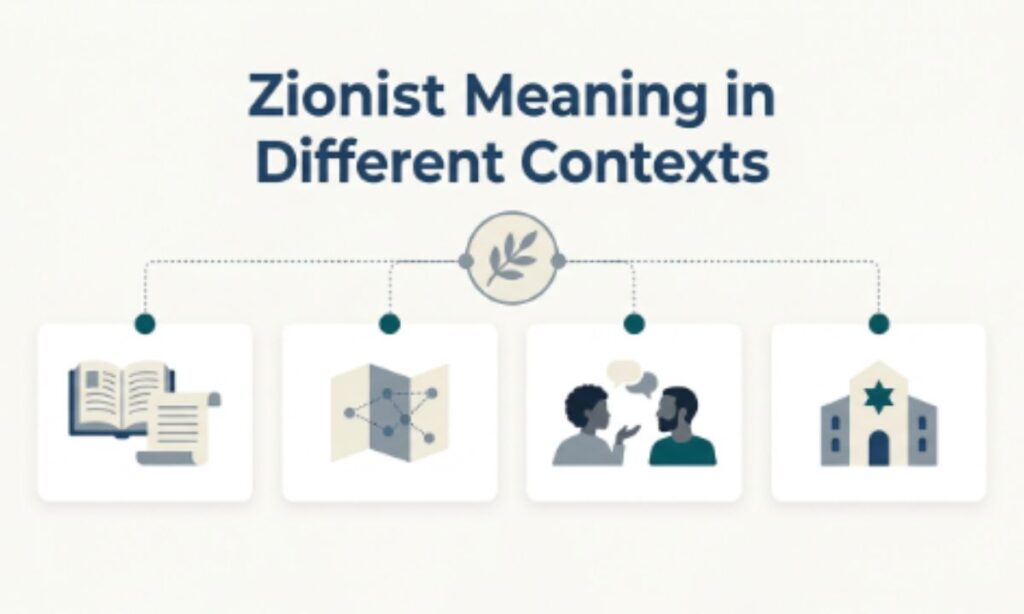
Zionist Meaning in Different Contexts
Historical Context
Historically, the Zionist meaning referred to someone actively involved in the late 19th and early 20th century movement to establish a Jewish state, including early settlers, organizers, and political figures who worked toward that goal before 1948.
Political Context
In modern political discussion, the Zionist meaning generally describes support for Israel’s existence and right to self-determination as a Jewish state. Within this context, people can hold very different views, ranging from strong support for current Israeli government policy to support for Israel’s existence while disagreeing sharply with specific policies.
Religious Context
In religious settings, the Zionist meaning can carry a theological dimension, particularly the belief that Jewish return to the land of Israel fulfills biblical prophecy or religious destiny. This view appears both within parts of Judaism and among some Christian denominations.
Is “Zionist” the Same as Jewish or Israeli?
No. Being Jewish refers to ethnic, cultural, or religious identity, while being Israeli refers to citizenship in the state of Israel. The Zionist meaning describes a political and ideological position, support for a Jewish homeland, that a person can hold regardless of their own religion or nationality. Many Jewish people do not identify as Zionists, and many non-Jewish people do.
What Is a Christian Zionist?
Applied to Christians, the Zionist meaning stays largely the same: a Christian Zionist is a Christian who supports the establishment and continuation of a Jewish state in Israel, often based on religious interpretation of biblical scripture.
Christian Zionism has been particularly influential in parts of the evangelical Christian community, especially in the United States, where support for Israel is often framed as a matter of faith as well as politics.
Is Supporting Zionism the Same as Supporting the Israeli Government?
Not necessarily. The Zionist meaning generally centers on supporting the existence of Israel as a Jewish homeland, but it does not automatically mean agreeing with every policy or action of any specific Israeli government or administration. Many self-described Zionists publicly criticize particular Israeli policies while still supporting the underlying idea of a Jewish state.
Why Is the Term Sometimes Used Negatively?
The Zionist meaning is sometimes stretched into a negative label, particularly in political debates connected to the Israeli-Palestinian conflict. Critics of Israeli government policy, or of the historical displacement of Palestinians tied to Israel’s founding, sometimes use the term to criticize those policies or that history.
Supporters of Israel often argue this usage unfairly conflates a legitimate national movement with specific political actions, or that it is sometimes used as a coded way to target Jewish people generally. Because the term sits at the center of a deeply contested and emotional geopolitical conflict, its tone can shift dramatically depending on the speaker’s intent and the listener’s perspective.
Is “Zionist” Considered Neutral, Political, or Offensive?
On its own, the Zionist meaning is neutral and descriptive, referring to someone who supports Jewish self-determination in Israel, and many people use it that way, including as a self-description. In political discourse, however, it frequently functions as a loaded term, used approvingly by supporters and critically by opponents. Whether the word feels neutral, political, or offensive in a given conversation usually depends heavily on context, tone, and the speaker’s intent.
What Is the Opposite of a Zionist?
The opposite of the Zionist meaning is anti-Zionism, and an anti-Zionist is someone who opposes the idea of a Jewish nation-state in Israel or opposes its continued existence in its current form.
Anti-Zionism itself covers a wide range of positions, from religious objections within some Jewish communities to political opposition rooted in Palestinian nationalism or broader critiques of nationalism itself.
Common Misunderstandings About the Term
People often get this wrong in a few predictable ways:
- Assuming all Jewish people are Zionists. Jewish identity and Zionist political belief are not the same thing, and opinions within Jewish communities vary widely.
- Assuming Zionist and Israeli mean the same thing. One describes political belief, the other describes citizenship.
- Assuming the term only applies to Jewish people. Christian Zionism and other non-Jewish forms of support for Israel are well documented.
- Treating the term as inherently insulting or inherently celebratory. Its tone depends entirely on context and intent.
Frequently Asked Questions
What is a Zionist in simple terms?
In simple terms, the Zionist meaning is someone who supports a Jewish homeland in the land of Israel.
What is the main goal of Zionism?
Zionism’s central goal is establishing and maintaining a secure, self-governing Jewish homeland in Israel.
Why is “Zionist” sometimes used negatively?
It’s sometimes used to criticize specific Israeli policies or the history tied to Israel’s founding, particularly regarding Palestinians.
Who founded Zionism?
Theodor Herzl is widely credited as the founder of the modern political Zionist movement, starting in the 1890s.
Is Zionism a religion?
No, Zionism is a political and national movement, though it has religious dimensions for some of its supporters.
Can “Zionist” mean different things in different contexts?
Yes, the Zionist meaning shifts across historical, political, and religious contexts, and its tone can range from neutral to highly charged.
Conclusion
The Zionist meaning is simple at its foundation: someone who supports a Jewish homeland in Israel. But the Zionist meaning carries layers of history, religion, and politics that make it far more complicated in practice.
Understanding where the word came from, how it’s used today, and why it sparks strong reactions on different sides of an ongoing conflict can help you engage with the topic more thoughtfully, whether you’re reading the news, studying history, or simply trying to understand a term you’ve heard used in very different ways.