
If you have landed here searching for the exact fascist meaning, you are not alone. The word shows up in news headlines, history classes, and everyday arguments, yet most people only have a fuzzy idea of what it actually stands for.
This guide breaks the term down in plain language, traces the word back to its Italian roots, and walks through real historical examples so you leave with a clear, confident understanding.
Quick Answer: What Does Fascist Mean?
The fascist meaning, in simple terms, refers to a person who supports or belongs to fascism, an authoritarian political system that puts the nation above the individual and crushes any opposition. As an adjective, “fascist” describes ideas, governments, or behavior linked to that same authoritarian control.
Fascist: Full Definition
Understanding the full definition requires looking at how the word functions as both a noun and an adjective.
As a noun: A fascist is simply a person who advocates for, belongs to, or actively supports fascism, a political movement or regime that glorifies the nation (and often a particular race) above individual rights, relies on a single dictatorial leader, and forcibly silences dissent.
As an adjective: “Fascist” describes anything connected to that ideology, such as a fascist government, a fascist party, or fascist propaganda. In casual speech, people also use it loosely to describe someone who is bossy, rigid, or intolerant of disagreement, even outside politics.
| Word Form | Function | Example |
|---|---|---|
| Fascist (noun) | Refers to a person or party member | “He was arrested as a known fascist.” |
| Fascist (adjective) | Describes a system, idea, or behavior | “The country fell under fascist rule.” |
| Fascism (noun) | Names the ideology itself | “Fascism spread through Europe in the 1920s.” |
Where Does the Word “Fascist” Come From?
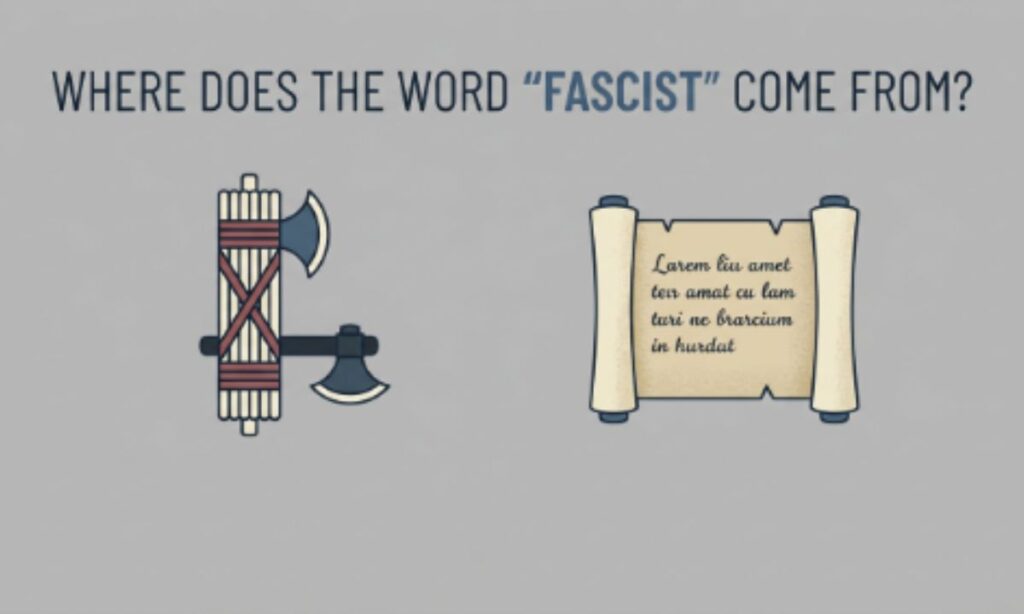
The fascist meaning traces directly back to Italy. The term comes from the Italian word fascio, meaning “bundle” or “group,” which was used long before the 20th century to describe labor unions and political associations.
In 1919, Benito Mussolini formed the Fasci di combattimento (“fighting bands” or “combat groups”), a nationalist political movement. Members were called fascisti, and the ideology they built became known as fascism.
The bundle symbol itself, a bound bundle of rods (the fasces), was an ancient Roman emblem of authority and unity, which Mussolini’s movement deliberately borrowed to signal strength and discipline.
What Is Fascism? (Core Characteristics)
To fully grasp the fascist meaning, it helps to look at the defining traits of fascism as a political system:
- Ultranationalism – an intense, often aggressive pride in the nation, frequently paired with the idea that the nation is superior to others.
- Authoritarian, one-party rule – power concentrated under a single leader or party, with little to no tolerance for competing parties.
- Suppression of opposition – censorship, propaganda, and force are used to silence critics, journalists, and rival political groups.
- Exalting nation and race above the individual – personal freedoms are secondary to the perceived needs of the state or ethnic group.
- Militarism – a strong emphasis on military strength, expansion, and glorification of war or struggle.
- Cult of personality – the leader is presented as the singular source of strength and direction for the nation.
Historical Examples of Fascist Governments
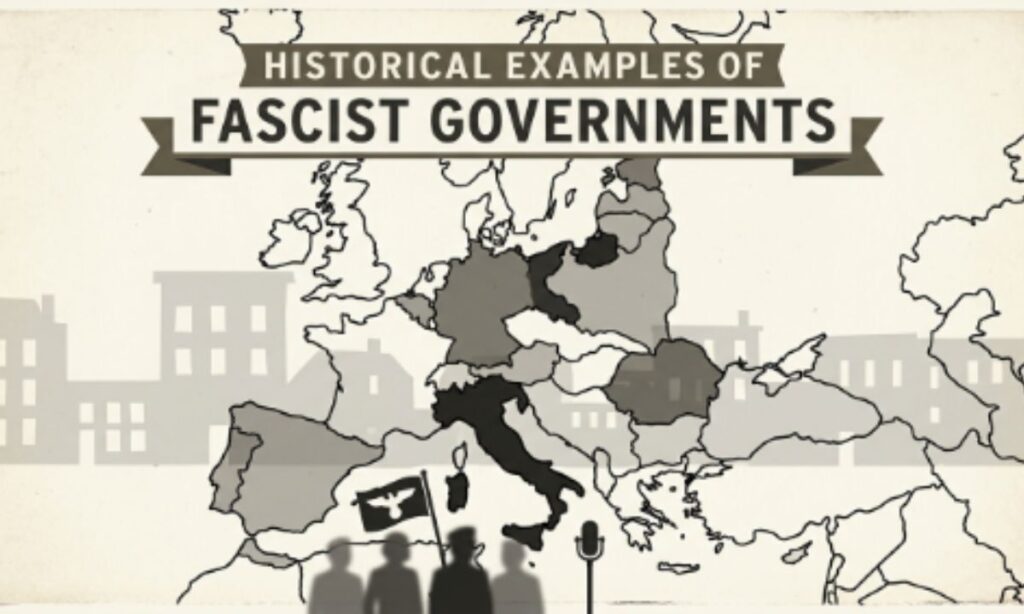
Real-world examples make the fascist meaning easier to picture. Three regimes are cited most often by historians and dictionaries alike.
Mussolini’s Italy
Benito Mussolini founded the original fascist movement in Italy and ruled as dictator from 1922 to 1943. His government banned opposition parties, controlled the press, and promoted extreme nationalism, giving the world both the term and the first working model of a fascist state.
Nazi Germany
Adolf Hitler’s regime, which ruled Germany from 1933 to 1945, is the most widely recognized example tied to the fascist meaning. It combined extreme nationalism with racial ideology, resulting in the suppression of dissent, aggressive military expansion, and the genocide of six million Jews during the Holocaust.
Francisco Franco’s Spain
Francisco Franco led Spain from 1939 to 1975 after winning the Spanish Civil War with support from fascist Italy and Nazi Germany. His government shared several fascist traits, including one-party control and suppression of political opponents, though historians often describe it as a more traditional authoritarian dictatorship than a fully fascist one.
Fascism vs. Authoritarianism vs. Totalitarianism
These three terms overlap but are not identical. Fascism is best understood as a specific, extreme subtype of authoritarianism, and it often overlaps with totalitarianism as well.
| Term | Core Idea | Key Feature |
|---|---|---|
| Fascism | Ultranationalist, one-party ideology that exalts nation/race over the individual | Combines extreme nationalism with dictatorship and forced unity |
| Authoritarianism | Broad term for concentrated, unchecked political power | Limits political freedom but doesn’t always control every part of life |
| Totalitarianism | Government seeks total control over public and private life | Regulates culture, economy, education, and personal beliefs |
In short, all fascist states are authoritarian, and many are also totalitarian, but not every authoritarian government is fascist.
Fascist as a Political Insult
Beyond the strict political fascist meaning, the word is frequently used loosely as an insult. People call a strict boss, a rigid teacher, or an overly controlling friend a “fascist” simply to describe rigid, bossy, or intolerant behavior, with no real connection to the historical ideology. Common informal phrases include “grammar fascist” or “food fascist,” used humorously to describe someone who is overly strict about rules.
Is Calling Someone “Fascist” Considered Offensive?
Whether the label is offensive depends heavily on context and intent, and reasonable people disagree on this point.
- Some view it as a serious accusation that should be reserved for genuine authoritarian behavior, since applying it carelessly can dilute the seriousness of real historical fascism.
- Others see it as a common exaggeration, similar to calling someone a “drama queen,” used for emphasis rather than a literal political claim.
- In political debate, the term is sometimes used strategically to delegitimize an opponent, which is why many style guides urge caution before using it about real people or parties.
Common Misunderstandings About Fascism
Fascism vs. Communism: Not the Same Thing
Fascism and communism are often confused because both are authoritarian systems, but they rest on opposite economic and social foundations. Fascism champions nationalism, private enterprise under state direction, and traditional hierarchy, while communism promotes international worker solidarity and collective ownership of property. Historically, fascist and communist movements were bitter rivals, not allies.
Is Fascism Left-Wing or Right-Wing?
Most historians and dictionaries classify fascism as a far-right ideology because of its emphasis on nationalism, traditional social hierarchy, and opposition to socialist and communist movements.
That said, fascism does not map neatly onto a simple left-right scale, since it also used state control of the economy, a tactic often associated with the left.
Fascist: Simple Definition (For Kids or Beginners)
In the simplest terms, the fascist meaning for beginners is this: a fascist is someone who believes one powerful leader and the nation should control everything, and that people should not be allowed to disagree or speak out against the government. Fascism is the system built around that belief.
How to Pronounce “Fascist”
The word “fascist” is pronounced FASH-ist (IPA: /ˈfæʃɪst/). The related noun “fascism” is pronounced FASH-iz-uhm. The “c” is silent, which trips up many first-time readers of the word.
Fascist Meaning in Other Languages
Arabic
In Arabic, fascism is commonly translated as fashiya (فاشية), and a fascist is fashi (فاشي), both borrowed phonetically from the original Italian term.
Chinese
In Chinese, fascism is written as fǎxīsī zhǔyì (法西斯主义), with fǎxīsī being a phonetic transliteration of “fascism” and zhǔyì meaning “ideology” or “-ism.”
Frequently Asked Questions
What does fascist mean, in simple terms?
A fascist is someone who supports an authoritarian system where one leader and the nation hold total power, and disagreement is not allowed.
What is a good example of fascism?
Mussolini’s Italy and Nazi Germany are the two most commonly cited historical examples of fascist governments.
Is fascism the same as authoritarianism?
No. Fascism is a specific, extreme form of authoritarianism that also emphasizes ultranationalism and suppression of opposition.
Is fascism left-wing or right-wing?
Fascism is broadly classified as far-right due to its nationalism and hierarchy, though it doesn’t fit a simple left-right scale perfectly.
Is calling someone a “fascist” an insult?
Yes, it’s often used as an insult or exaggeration for controlling behavior, though it can also be a serious political accusation.
How do you explain fascism to a child?
Tell them fascism means one powerful leader controls the whole country and won’t let people disagree or have a say.
Where does the word “fascist” come from?
It comes from the Italian word fascio (“bundle”), used by Mussolini’s Fasci di combattimento movement starting in 1919.
Final Thoughts
The fascist meaning is more than a dictionary entry. It is a word rooted in a specific, documented history, from Mussolini’s Italy to Nazi Germany, and it carries real weight because of the suffering those regimes caused.
At the same time, the word has drifted into everyday slang, where it simply means someone acting bossy or controlling. Knowing both the strict definition and its casual, informal use helps you read the news, join a debate, or explain history to a curious kid with real confidence and clarity.