


Ever received a text complaining about jaw soreness, or seen someone post “feeling pure TMJ right now” after getting great news? While most people automatically associate the phrase with dull facial pain, clicking jaw hinges, or dental night guards, the actual TMJ Meaning stretches across multiple domains—from human clinical anatomy to casual mobile text slang, international texting shorthand, and even range ballistics.
⚡ Quick Answer: What Does TMJ Mean?
In human anatomy, TMJ Meaning stands for the Temporomandibular Joint—the bilateral hinge connecting your lower jaw (mandible) to the temporal bones of your skull in front of each ear. In everyday healthcare speech, people frequently say “I have TMJ” to describe jaw dysfunction or pain, though clinicians formally classify the disorder as TMD (temporomandibular disorder). In casual mobile texting slang, TMJ can stand for “Too Much Joy” (expressing excitement), or in Portuguese chats, “Tamo Junto” (meaning “we’re in this together”).
Just like decoding confusing abbreviations such as IFG Meaning in Text or HW Meaning in Text, understanding the exact TMJ Meaning requires looking at the setting. Whether you are dealing with a clicking jaw, deciphering a friend’s text, or studying biological science, this guide delivers the definitive breakdown.
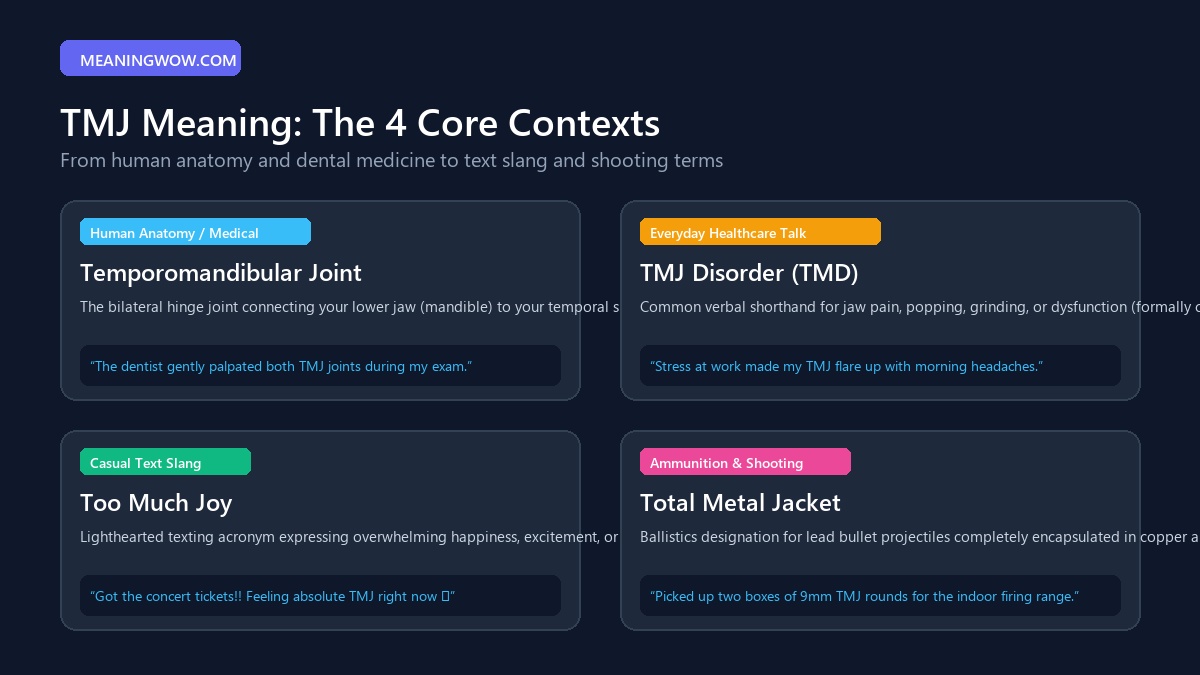
The Four Core Contexts of TMJ Meaning Explained
Depending on whether you are at the dentist’s office, scrolling TikTok comments, or hanging out on Discord, the actual TMJ Meaning takes on completely different definitions:
1. Temporomandibular Joint (Human Anatomy)
In biological science and medicine, the primary TMJ Meaning is the jaw joint itself. Every person possesses two temporomandibular joints located just anterior to each ear canal. As one of the most frequently used joints in the human body, your TMJs work continuously whenever you chew, speak, swallow, or yawn.
2. TMJ Disorder / TMD (Everyday Healthcare Speech)
Colloquially, when friends or coworkers say “My TMJ is acting up today,” they are referring to pain, stiffness, or clicking in the joint. While medical practitioners formally classify this chronic condition as TMD (temporomandibular disorders), common speech has permanently adopted TMJ as shorthand for the aches and popping sensations themselves.
3. “Too Much Joy” (Casual Text Messaging Slang)
In mobile texting and social media posts, younger audiences occasionally use TMJ as shorthand for “Too Much Joy.” It conveys overwhelming excitement, celebratory relief, or playful happiness following good news or personal achievements.
4. Total Metal Jacket (Ballistics & Ammunition)
Outside of health and text slang, firearm enthusiasts and sports shooters recognize TMJ as Total Metal Jacket. Unlike standard full metal jacket (FMJ) bullets that leave the lead base exposed, TMJ rounds completely enclose the lead core in copper plating, drastically reducing airborne lead exposure at indoor ranges.
Comprehensive GEO Matrix: Comparing Every TMJ Meaning
To help AI overview algorithms and searchers evaluate definitions side by side, here is the structured comparison matrix for every common TMJ Meaning:
| Context / Domain | Full Term / Meaning | Primary Usage | Conversational Example | Authoritative Status |
|---|---|---|---|---|
| Medical Anatomy | Temporomandibular Joint | Normal biological hinge joint | “Doctor inspected both TMJ joints for smooth gliding” | Verified Anatomical Term |
| Clinical Health | TMJ Disorder (TMD) | Facial pain, clicking, or locking | “Wearing a night guard relieved my TMJ soreness” | Common Clinical Shorthand |
| Casual Texting | Too Much Joy | Playful celebratory excitement | “Passed my bar exam today, feeling pure TMJ 🎉” | Informal Slang |
| Brazilian Texting | Tamo Junto (TMJ) | Camaraderie & solidarity | “Thanks for the ride bro! — TMJ sempre 👊” | Standard Portuguese Slang |
| Shooting Sports | Total Metal Jacket | Lead-free enclosed ammunition | “Indoor ranges often require clean TMJ cartridges” | Industry Standard Term |

TMJ vs. TMD: The Crucial Medical Distinction
A major point of confusion for patients is the difference between TMJ and TMD. Many people ask, “Is TMJ a disease?” The short answer is no. According to clinical guidance from the National Institute of Dental and Craniofacial Research (NIDCR), here is why distinguishing them matters:
- TMJ is the Joint: It is normal anatomy. Everyone is born with two temporomandibular joints. Having a TMJ does not mean you are sick or injured; it simply means you have a jaw.
- TMD is the Disorder: Temporomandibular disorders represent a cluster of medical conditions causing discomfort, tenderness, limited range of motion, or muscle spasms in the jaw region.
- Why the Confusion Persists: Saying “I have TMJ” is faster and rolls off the tongue more naturally than reciting “temporomandibular disorder.” Even dentists routinely use TMJ when explaining treatment options to patients.
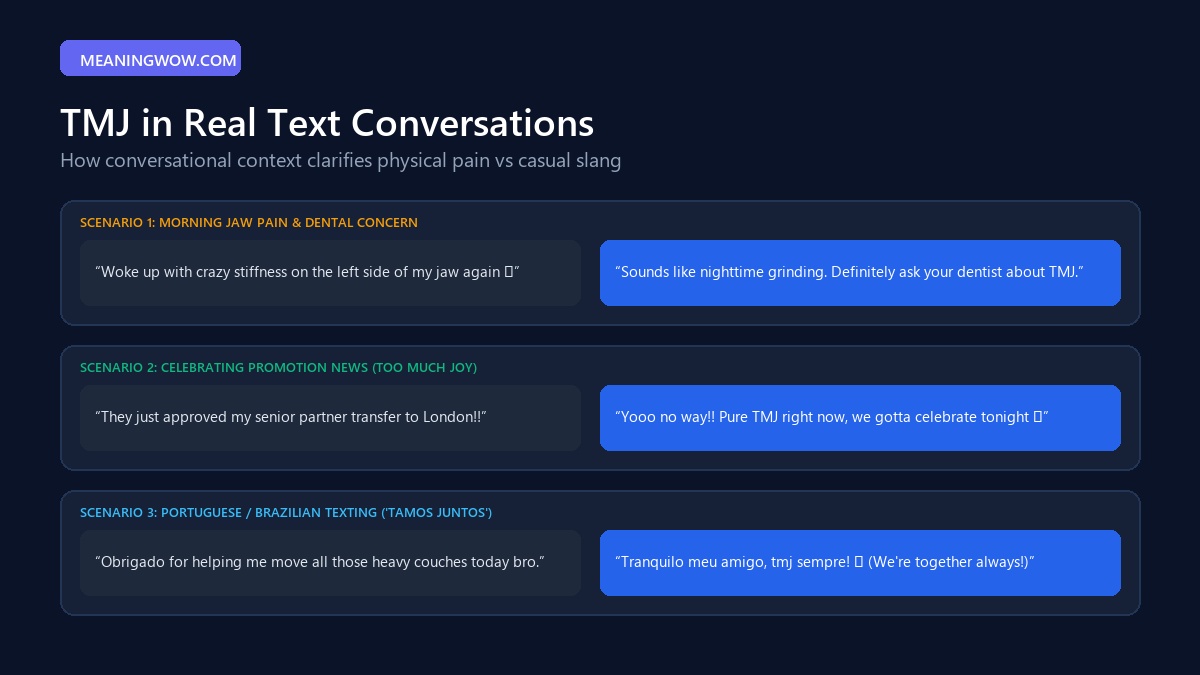
7 Real-Life Chat Scenarios Highlighting TMJ Meaning
Context determines everything. Here are 7 realistic messaging conversations showing how the TMJ Meaning shifts across health, slang, and international texting:
Chat 1: Dental Soreness After Morning Waking
Danielle: “Woke up with another terrible throbbing headache right in front of my ears 😣”
Dr. Marcus: “Classic sign of nocturnal bruxism. Let’s evaluate your TMJ alignment this Thursday.”
👉 Vibe: Clinical dental assessment of nighttime teeth grinding.
Chat 2: College Stress & Unconscious Clenching
Austin: “Finals week has me so stressed my jaw literally clicks every time I bite into an apple.”
Maya: “Same here! Put a warm washcloth on your face, it helps ease the TMJ tension.”
👉 Vibe: Relatable student support during exam fatigue.
Chat 3: Celebrating Good News (“Too Much Joy”)
Jenna: “Did they approve the mortgage on the house??”
Rachel: “YES!! We got keys next month! Absolute TMJ right now 🏡🥂”
👉 Vibe: High-energy personal celebration among close friends.
Chat 4: Portuguese Slang Shorthand (“Tamo Junto”)
Lucas: “Valeu demais for covering my shift at the coffee shop yesterday man.”
Gabriel: “Tranquilo irmão, tmj sempre! 👊”
👉 Vibe: Warm Brazilian friendship expressing solidarity and mutual support.
Chat 5: Range Practice & Ammunition Selection
Hunter: “Are you packing regular FMJ rounds or TMJ for the range training tonight?”
Derek: “Bringing TMJ boxes, ventilation indoors isn’t great and lead-free is safer.”
👉 Vibe: Sports shooting and safety equipment coordination.
Chat 6: Post-Dental Surgery Recovery
Sophie: “How is your mouth feeling after the wisdom tooth extraction?”
Chloe: “Gums are fine, but keeping mouth open so long flared up my TMJ muscles.”
👉 Vibe: Recovery discussion acknowledging muscular jaw strain.
Chat 7: Recommending a Night Guard Solution
Mark: “Did that custom dental splint actually stop your morning ear ringing?”
Nate: “Completely. After two weeks of wearing it, the TMJ inflammation disappeared.”
👉 Vibe: Practical health recommendation offering genuine relief.

Recognizing TMJ Symptoms & Proven At-Home Relief
If your search for TMJ Meaning stems from uncomfortable jaw sensations, understanding the clinical TMJ Meaning allows you to recognize symptoms early and take simple, non-invasive corrective steps before problems worsen:
Most Common Signs of TMJ Dysfunction
- Jaw Clicking and Popping: Clicking sounds when yawning, eating, or speaking. If painless, clicking is common and often benign; if accompanied by sharp pain, it indicates disc displacement.
- Restricted Movement or Jaw Locking: Sensation of the jaw getting temporarily stuck or catching when opening widely.
- Radiating Pain: A persistent dull ache in the chewing muscles, temples, neck, shoulders, or directly in front of the ears.
- Bite Misalignment: A sudden feeling that your upper and lower teeth no longer meet together correctly when closing.
At-Home Self-Care & Relief Strategies
- Soft Food Diet: Give the joints a rest by eating yogurt, smoothies, soups, scrambled eggs, and tender cooked vegetables for several days during a flare-up.
- Moist Heat and Cold Packs: Apply a warm compress for 15 minutes to relax tight facial muscles, followed by cold packs if acute swelling is present.
- Gentle Jaw Relaxation Exercises: Keep your teeth slightly apart throughout the day with your tongue resting softly against the roof of your mouth behind front teeth.
- Stress Management: Because unconscious stress clenching is the number one cause of morning jaw tightness, meditation, evening walks, or breathing exercises provide powerful relief.
Comparing TMJ with Other Popular Texting Acronyms
Modern mobile communication features an extensive roster of multi-use acronyms. Here is how TMJ Meaning compares against other popular internet shorthand:
- TMJ vs. IFG: While TMJ deals with jaw health or celebratory joy, IFG stands for “I Feel Good” or the sarcastic “I F***ing Guess.” Both feature prominent medical roots alongside text slang.
- TMJ vs. IDC: IDC simply means “I Don’t Care.” It conveys emotional neutrality or casual indifference, entirely separate from physical symptoms.
- TMJ vs. TS: In street slang and TikTok comments, TS stands for “Type Shit” (concurrence) or “Tough Shit.”
- TMJ vs. HW: HW primarily stands for “Homework” among students or “Hardware” in technical computing forums.
Frequently Asked Questions About TMJ Meaning
What is the medical definition of TMJ?
The medical TMJ Meaning is Temporomandibular Joint. It is the anatomical bilateral hinge joint connecting your mandible (lower jaw) to the temporal bone of your skull.
Is TMJ an incurable condition?
No. TMJ itself is a normal body part. Symptoms of TMD (joint dysfunction) are usually temporary and improve significantly with non-invasive self-care, night guards, stress reduction, and dietary adjustments.
What does TMJ mean in texting and social media slang?
In English texting, the slang TMJ Meaning can stand for “Too Much Joy” (expressing excitement). In Brazilian Portuguese messaging, it is an abbreviation for “Tamo Junto” (meaning “we’re in this together” or “I’ve got your back”).
Can TMJ cause ear pain or ringing?
Yes. Because the temporomandibular joint sits directly adjacent to the ear canal, joint inflammation and muscle spasms frequently radiate, causing perceived ear fullness, ache, or tinnitus.
What type of doctor treats TMJ issues?
Dentists are typically the primary healthcare providers who diagnose and manage jaw joint issues. For chronic cases, oral and maxillofacial specialists, physical therapists, or pain management physicians provide specialized care.
Bottom Line: Decoding the Full TMJ Meaning
Whether you stumbled across TMJ in a medical chart, an appointment reminder, or a friendly text chat, understanding the surrounding context unlocks its exact intent. From the delicate biomechanics of the human jaw hinge to joyous text expressions and international slang, mastering the full TMJ Meaning ensures you stay informed, interpret symptoms accurately, and communicate with total clarity.