
Quick Answer: The agnostic meaning describes someone who believes the existence of God or a higher power is unknown or unknowable. It isn’t the same as not caring or feeling unsure.
It’s a genuine philosophical position. In technology and business, “agnostic” is used very differently, describing something that works independently of any specific platform, brand, or system, like “cloud-agnostic” software.
Key Takeaways
- The agnostic meaning centers on the belief that God’s existence is unknown or unknowable, not simple uncertainty.
- The word was coined in 1869 by biologist Thomas Henry Huxley, built from the Greek a- (“without”) and gnostos (“known”).
- Agnosticism concerns knowledge, while atheism and theism concern belief, so a person can be both agnostic and atheist, or agnostic and theist.
- In technology and business, “agnostic” means independent of a specific platform, vendor, or system.
- Common examples include platform-agnostic software, technology-agnostic tools, and model-agnostic methods in data science.
Agnostic Isn’t a Maybe — It’s a Position

People often treat agnosticism as a shrug, a placeholder for “I haven’t decided yet.” That’s a common misread of the agnostic meaning. Agnosticism isn’t indecision. It’s a considered stance on the limits of human knowledge itself.
An agnostic isn’t saying, “I don’t know and I don’t care.” They’re saying, “This question may not be answerable with certainty, so I won’t claim to know either way.” That’s a coherent philosophical position, not a lack of one.
What Does Agnostic Mean?
At its core, the agnostic meaning refers to a belief about the limits of knowledge, specifically regarding God, a higher power, or the ultimate nature of reality. An agnostic holds that such questions are unknown, and possibly unknowable, rather than confidently answerable.
Dictionaries generally define agnostic in two related ways:
- Someone who believes the existence of God is unknown or unknowable
- Someone who is not committed to believing in either the existence or nonexistence of God
Both definitions circle the same idea: agnosticism deals with knowledge and certainty, not simply belief.
Agnostic Meaning in Religion and Philosophy
In religious and philosophical contexts, the agnostic meaning is specifically about epistemology, the study of what can actually be known. An agnostic doesn’t necessarily reject the idea of God. They reject the claim that anyone can know for certain whether God exists.
This distinction matters. Theists believe in God. Atheists don’t believe in God. Agnostics take a separate position entirely: they hold that certainty, in either direction, isn’t achievable through evidence or reason alone.
A Simple Example
Someone might say, “I don’t know if there’s a God, and I don’t think anyone else truly does either.” That statement captures the agnostic meaning precisely: a position built on the limits of knowledge, not on a lack of interest in the question.
Is Agnostic the Same as Atheist?
No, though the two are frequently confused. Atheism is about belief: an atheist does not believe in God. Agnosticism is about knowledge: an agnostic believes the answer isn’t knowable with certainty.
| Agnostic | Atheist | |
|---|---|---|
| Core question | Can this be known? | Do I believe this? |
| Position | Existence of God is unknown or unknowable | Does not believe in God |
| Focus | Knowledge and certainty | Belief and conviction |
Because these terms address different questions, someone can technically hold both positions at once, which brings us to the next distinction.
Agnostic Atheist vs Agnostic Theist: What’s the Difference?
Since agnosticism concerns knowledge and theism/atheism concerns belief, the two can combine.
- Agnostic atheist: Doesn’t believe in God, while also accepting that certainty isn’t possible. They lack belief without claiming to know for sure.
- Agnostic theist: Believes in God, while also accepting that this belief can’t be proven with certainty. Faith, not proof, drives the belief.
This combination is a key part of understanding the fuller agnostic meaning: it’s a lens on knowledge that can sit alongside belief in either direction.
Can Agnostics Believe in God?
Yes. This surprises people who assume agnosticism rules out belief entirely. An agnostic can lean toward belief, lean toward disbelief, or hold neither position strongly. What defines agnosticism isn’t the presence or absence of belief, but the admission that the question can’t be answered with full certainty.
What Does “Agnostic” Mean in Technology and Business?
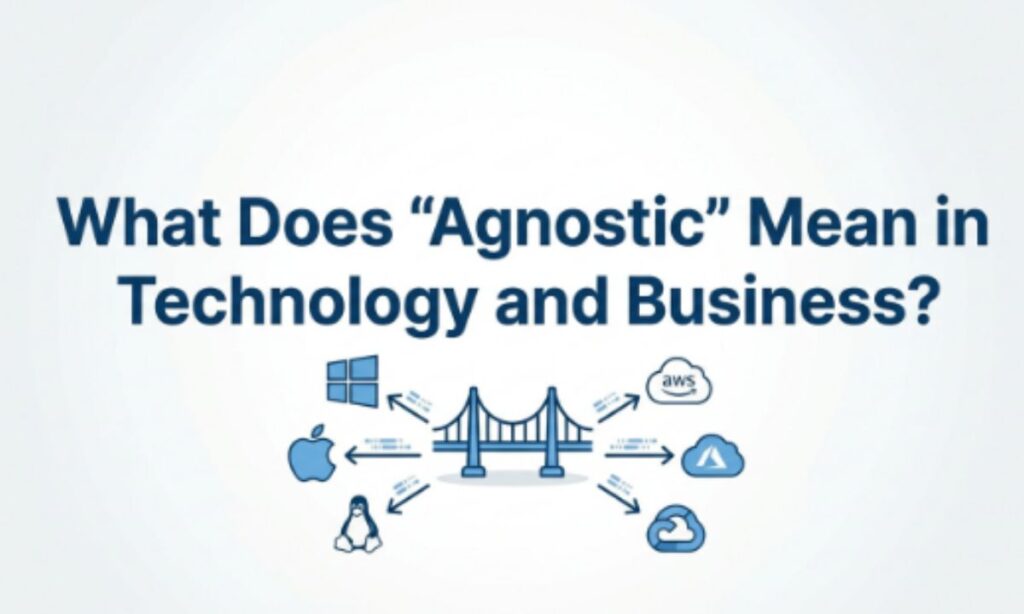
Outside religion and philosophy, the agnostic meaning shifts entirely. In technology and business, “agnostic” describes something built to work independently of any specific platform, brand, tool, or system.
Platform-Agnostic
Software or tools described as platform-agnostic work across multiple operating systems or devices without requiring modification.
Technology-Agnostic and Cloud-Agnostic
A technology-agnostic approach isn’t tied to one specific tool or framework. Cloud-agnostic systems are built to run across multiple cloud providers rather than locking into just one.
Model-Agnostic (Data Science and AI)
In data science, a model-agnostic method can be applied to any machine learning model, regardless of its internal structure or algorithm.
Vendor-Agnostic and Brand-Agnostic
A vendor-agnostic or brand-agnostic solution doesn’t favor or depend on any single supplier, giving businesses flexibility to switch providers freely.
Real Conversation and Usage Examples
Friends Discussing Belief
“I’m agnostic. I just don’t think anyone can really know for sure.”
Workplace Technology Discussion
“We built the platform to be cloud-agnostic, so it isn’t locked into one provider.”
Choosing Between Options
“I’m agnostic about which tool we use, as long as it gets the job done.”
Common Mistakes and Misconceptions About Agnostic
- Assuming agnostic means simply “unsure” or “indifferent”
- Treating agnostic and atheist as interchangeable terms
- Believing agnostics can’t hold religious beliefs at all
- Forgetting that “agnostic” has an entirely separate, common meaning in technology
Similar Terms to Agnostic
| Term | Core Meaning |
|---|---|
| Atheist | Does not believe in God |
| Theist | Believes in God |
| Skeptic | Questions and doubts claims generally, not limited to religion |
| Secular | Not connected to religious matters |
Origin of the Word Agnostic
The word agnostic was coined in 1869 by English biologist Thomas Henry Huxley. He built it from the Greek prefix a-, meaning “without,” and gnostos, meaning “known,” deliberately positioning it as the opposite of “gnostic.”
Huxley created the term to describe a position grounded in intellectual honesty about the limits of human knowledge, rather than a rejection of belief itself. Understanding this origin adds real depth to the modern agnostic meaning we use today.
Frequently Asked Questions
What does agnostic mean in simple terms?
It means believing that whether God exists is unknown or unknowable, rather than confidently believing or disbelieving.
What is the difference between atheist and agnostic?
Atheism is about belief (not believing in God), while agnosticism is about knowledge (believing certainty isn’t possible).
Can agnostics believe in God?
Yes. An agnostic can lean toward belief while still accepting that certainty can’t be proven.
What is a synonym for agnostic?
Common synonyms include skeptic, doubter, and unbeliever, though none captures the term precisely.
What does “technology-agnostic” mean?
It means a tool or system works independently of any specific platform, provider, or technology.
Can agnostic have different meanings depending on context?
Yes. In religion and philosophy it concerns belief and knowledge about God, while in technology and business it means independence from a specific platform or vendor.
Conclusion
The agnostic meaning carries far more weight than a simple shrug of uncertainty. Rooted in Thomas Huxley’s 1869 coinage, it represents a genuine, well-reasoned position on the limits of human knowledge, one that can coexist with belief, disbelief, or anything in between.
Outside religion, the same word takes on a completely practical meaning, describing flexible, independent technology built to work anywhere. Understanding both sides of the agnostic meaning gives you a truly insightful way to use the word accurately, whichever context you’re speaking in.